Briefing · August 29, 2026
What Samantha Lawler Just Got Right About a Million Satellites and the Night Sky
Astronomer Samantha Lawler's 2026 model shows orbital AI data-centre satellites could outnumber visible stars—a finding every space power planner needs to read.
Who Is Samantha Lawler, and Why Should Space Power Readers Care?
Samantha Lawler is an astronomer who does the quantitative work that advocacy documents routinely skip. In 2026, working with two colleagues, she built a rigorous orbital model of SpaceX's publicly stated proposal to deploy one million orbital artificial-intelligence data-centre satellites and ran it against the actual brightness and sky-coverage geometry that such a constellation would produce. The result is the clearest numerical warning yet that orbital infrastructure decisions made for power and computing economics will carry hard physical costs for everyone on Earth — costs that no launch manifest currently prices in.
What Did Lawler's Model Actually Show?
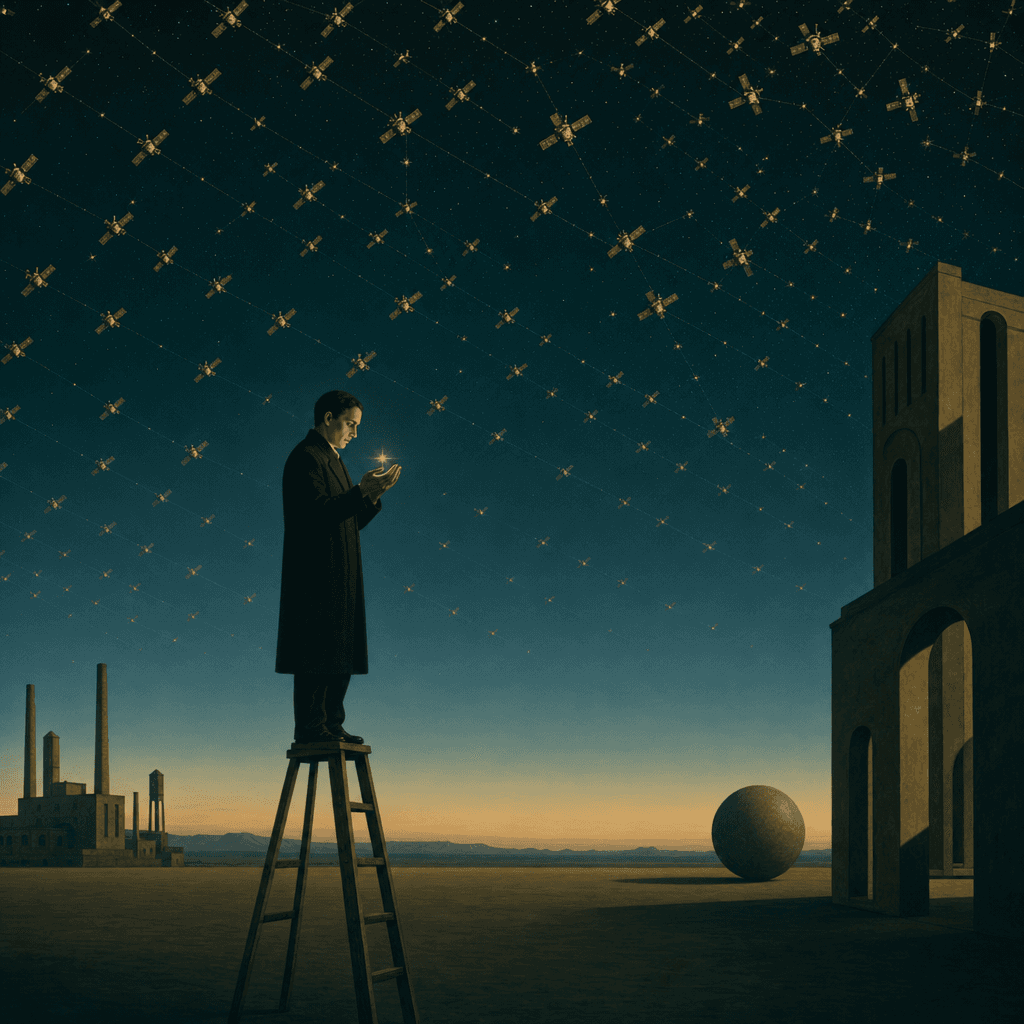
Lawler and her co-authors found that, if the proposed satellites are launched at the assumed sizes and reflectivity, naked-eye satellites could outnumber visible stars for large portions of the night and year almost everywhere on Earth, according to Space Daily (2026). That is not a poetic concern — it is a geometry problem. At one million objects in low Earth orbit (LEO), the angular density of artificial point sources saturates the unaided human visual field during twilight and, in high-latitude winters, throughout much of the night. The finding matters to this readership because the power architecture of those proposed satellites — whatever mix of photovoltaics, power-beaming reception, or nuclear betavoltaics they eventually carry — cannot be evaluated in isolation from the cumulative orbital environment they would create.
Orbital computing and sky brightness: Space-based AI data centres are being seriously proposed partly because securing grid power for terrestrial facilities in parts of Britain and North America can take five to fifteen years due to grid queues, permitting delays, and community opposition, as reported by Space Daily (2026). That is a real infrastructure bottleneck, and the orbital argument is not frivolous on its face. But Lawler's model forces a discipline that the orbital-computing pitch currently lacks: what is the per-satellite sky-brightness budget that keeps the constellation below the threshold where satellites outnumber stars, and can the power and thermal architecture of each node be designed to meet it?
Why This Is Signal, Not Noise, for Space Solar Planners
Space-based solar power (SBSP) is defined as the collection of solar energy in orbit via large photovoltaic or concentrator arrays, conversion to microwave or laser radiation, and transmission to ground receivers for use in terrestrial electricity grids. Reflectivity and apparent magnitude are already design constraints for SBSP platforms — the same parameters Lawler's team modelled. A one-gigawatt-class SBSP platform in geostationary Earth orbit (GEO) at roughly 35,786 km altitude presents a very different sky-brightness profile than a LEO data-centre satellite at 500 km, but the underlying photometric methodology is identical. Lawler's framework is therefore directly portable: any SBSP developer proposing a LEO or medium Earth orbit (MEO) demonstration constellation now has a peer-reviewed modelling approach to cite — or to rebut — when regulators ask about cumulative brightness impact.
The context is also commercially urgent. The European Space Agency (ESA) has signed contracts totalling €543.6 million under its European Launcher Challenge with Isar Aerospace, Rocket Factory Augsburg, and PLD Space, as reported by European Spaceflight (2026), accelerating the cadence at which large constellations can realistically be launched from European soil. More launch capacity means faster orbital population growth, which makes Lawler's ceiling calculations more time-sensitive, not less.
The Actionable Takeaway for Your Roadmap
If you are scoping a satellite power architecture — whether for an SBSP demonstrator, an orbital computing node, or a surface-power relay — Lawler's 2026 paper gives you a concrete modelling obligation: calculate your constellation's contribution to naked-eye satellite density at the proposed orbital altitude and inclination, and document the reflectivity spec required to stay below the threshold where satellites outnumber visible stars. This is not a regulatory requirement today, but Lawler's work is precisely the kind of quantified, peer-reviewed finding that ends up in International Telecommunication Union (ITU) coordination frameworks and national spectrum and orbital-use policies within a regulatory cycle or two.
The path from lab demo to bankable power plant runs through public and regulatory legitimacy. Samantha Lawler has just handed the industry both a warning and a methodology: use both before your next orbital slot filing lands on a regulator's desk.
Created with AI assistance. Editorial oversight: Juergen Ritzek. See our AI disclosure.