Briefing · November 21, 2026
What Kevin Hell Just Got Right About Affordable Solar Power in Space
mPower's CEO makes the engineering case for silicon-based, ultra-lightweight solar as the cost-credible path to powering the emerging space economy.
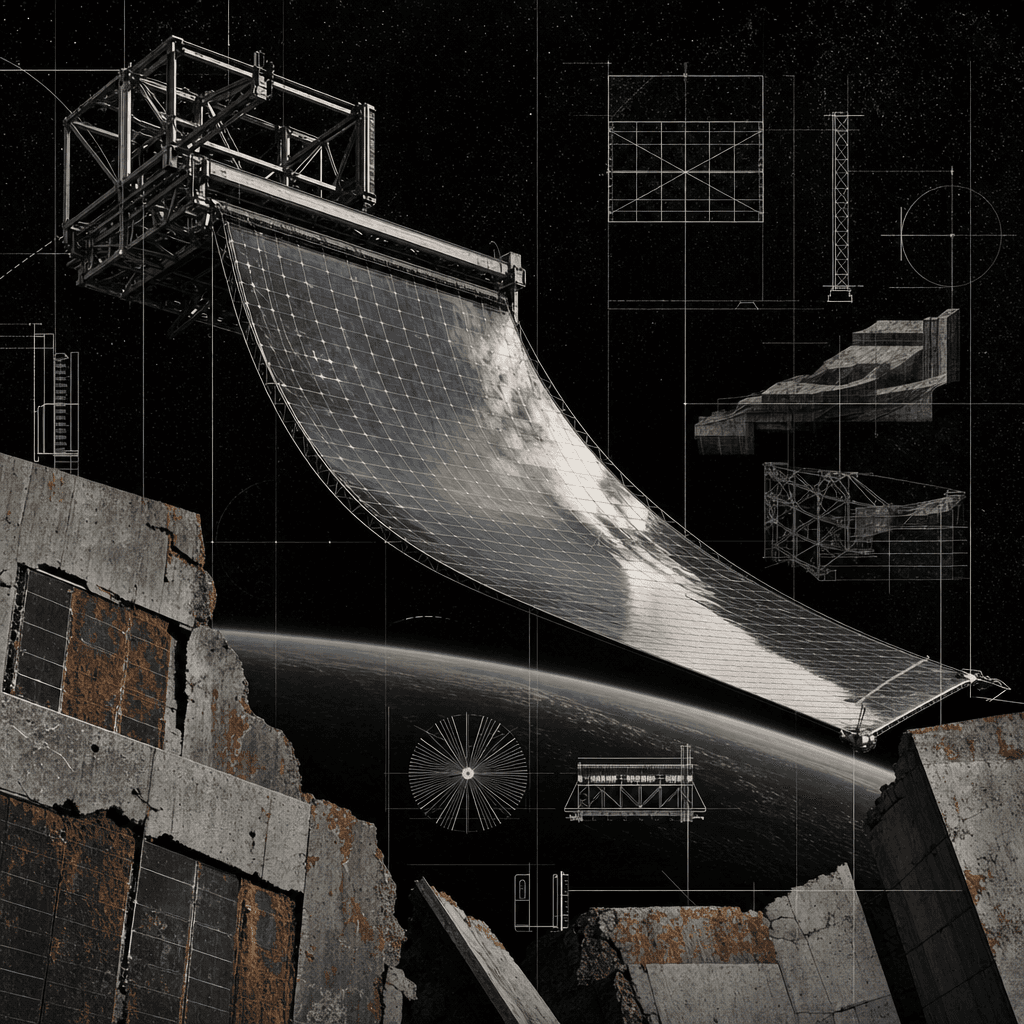
Who Is Kevin Hell, and Why Should You Listen?
Kevin Hell is the President and Chief Executive Officer (CEO) of mPower Technology, a company that manufactures silicon-based flexible solar arrays purpose-built for the cost and mass constraints of commercial space operations. Hell is not a conference-circuit visionary — he is an operator whose product roadmap is grounded in specific power figures, production economics, and the launch-cost arithmetic that determines whether in-space solar is a viable business or a perpetual prototype. This week, he made the clearest public case yet for why silicon — not the exotic multi-junction cells that dominate aerospace heritage — is the right answer for an expanding space economy.
What Does mPower's Approach Actually Mean for In-Space Power?
Space-based solar power for satellites and spacecraft works on a straightforward principle: photovoltaic cells convert sunlight — available continuously in many orbits without atmospheric loss — into electricity that runs onboard systems. The engineering challenge is that every gram of solar panel you launch costs money, so specific power (watts produced per kilogram of panel mass, W/kg) is the metric that determines whether a design is commercially viable. Higher W/kg means less mass to orbit for the same electrical output, which directly reduces launch costs per watt delivered.
Hell's argument, as laid out in a pv magazine (2026-11-20) interview, is that mPower's ultra-lightweight, flexible silicon solar technology delivers a specific power and cost profile competitive enough to serve the accelerating demand for in-orbit power — from small satellites to the emerging class of space-based data infrastructure. The core claim: silicon, long dismissed in aerospace in favor of expensive multi-junction cells, can now be manufactured in thin, flexible formats that close the mass budget at a price point multi-junction cannot match for high-volume commercial missions.
This is a materially different value proposition from heritage space solar, and it deserves scrutiny. Multi-junction cells routinely achieve 28–32% efficiency in orbit, but their cost per watt is orders of magnitude higher than silicon. mPower's bet is that for a large and growing segment of the market — commercial low-Earth orbit (LEO) constellations, in-space servicing platforms, and the nascent orbital data-centre concept — good-enough efficiency at dramatically lower cost and mass wins. That is an engineering argument, not a marketing one, and it maps directly onto the economics of falling launch costs.
Why Does This Matter to Your Roadmap Right Now?
The timing of Hell's interview is not accidental. The demand signal for affordable in-space power is sharpening from multiple directions simultaneously. Korean space solar firm Flexell Space and French partner Alatyr are actively pursuing solar technology for space-based artificial intelligence (AI) data centres, a use case that would require sustained kilowatts of on-orbit power per node — far beyond what a communications satellite needs today. If orbital data infrastructure scales even modestly, the addressable market for in-space solar arrays grows by an order of magnitude, and cost-per-watt becomes the decisive procurement criterion.
Simultaneously, launch economics are shifting the calculus. SpaceX Starship flights 14 and 15 each placed 26 Starlink satellites into orbit, equivalent to roughly 20 Falcon 9 launches per flight. If full reusability is achieved, analysts project mass-to-orbit capacity could increase 10–20× by 2027. Lower launch costs do not eliminate the W/kg constraint — panel mass still costs money — but they do expand the design space in which silicon-based flexible arrays become economically attractive relative to premium multi-junction solutions.
What Is the Actionable Takeaway?
Hell's contribution this week is not a new demo result or a contract announcement — it is a disciplined, public articulation of the technical and economic case for a specific technology choice at a moment when the market is deciding its standards. For program officers and procurement engineers evaluating solar arrays for next-generation commercial platforms, the question Hell forces is concrete: at your projected launch cost and mission power requirement, does the specific power and unit cost of your current panel specification still justify the multi-junction premium, or has the crossover point arrived?
Run that calculation before your next supplier down-select. mPower is making the case that for many commercial missions launching in the next two to three years, the crossover has already occurred, and silicon is now the defensible choice — not a compromise.
Created with AI assistance. Editorial oversight: Juergen Ritzek. See our AI disclosure.