Briefing · July 24, 2026
What Dr. Sarah Wolff Just Got Right About Building on the Moon
Wolff's laser-based 3D printing approach turns lunar regolith into structural material — here's why it belongs on every surface power roadmap.
Who She Is
Dr. Sarah Wolff is a materials engineer whose lab has been quietly solving one of the most stubborn problems in lunar infrastructure: how do you build anything permanent on a world where every kilogram of hardware costs a fortune to ship? Her answer — use the Moon's own dirt — has moved from theory to demonstrated hardware, and the timing matters enormously for anyone planning surface power assets under the Artemis program.
The Contribution That Earns the Spotlight
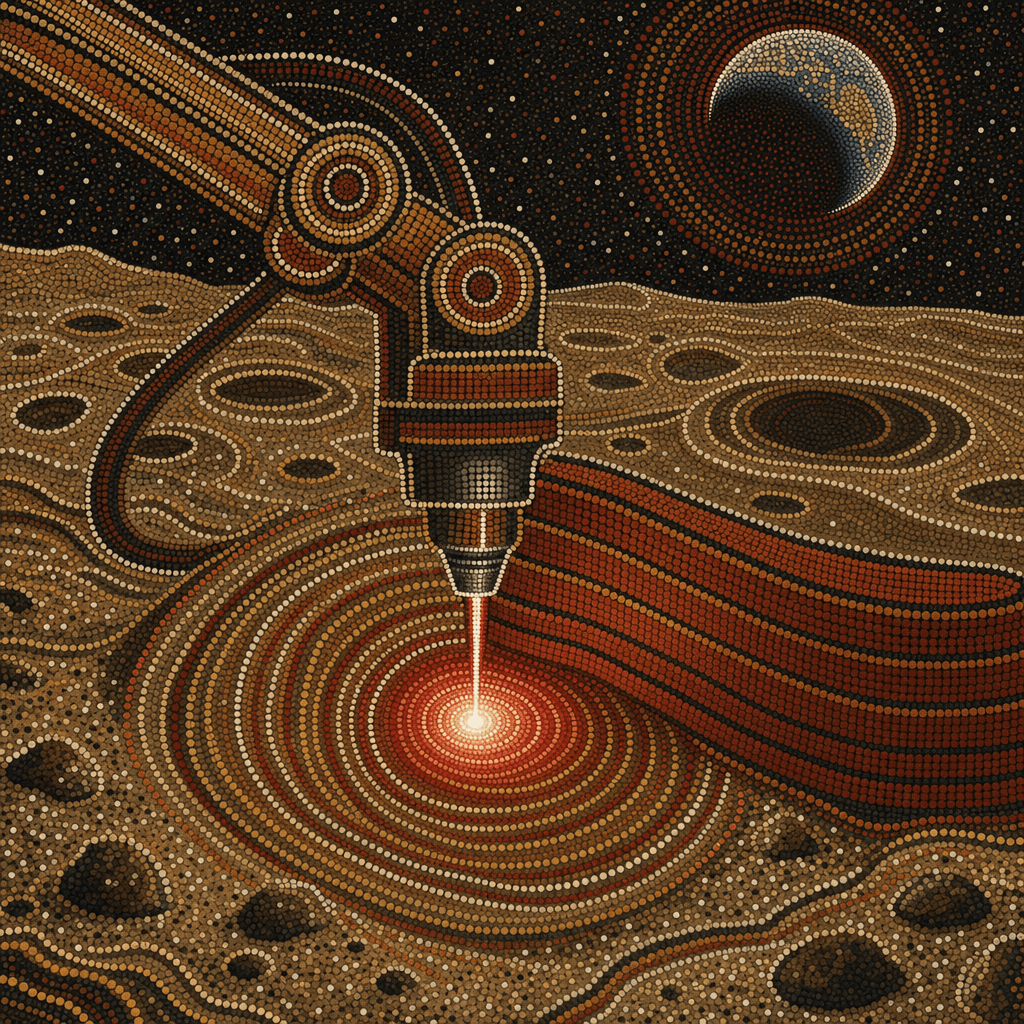
Wolff and her team are developing a laser-based directed energy deposition process that sinters lunar regolith simulant into load-bearing structures, eliminating the need to launch prefabricated building material from Earth. According to IEEE Spectrum (2026), the approach leverages the same family of powder-bed laser systems used in terrestrial additive manufacturing, adapted for the thermal extremes and vacuum conditions of the lunar surface. The key engineering insight is that the Moon's regolith — already present in essentially unlimited supply at any landing site — contains the silicate and oxide compounds that, when laser-melted and resolidified, produce a ceramic-like material with genuine structural integrity.
This is not a simulation. Wolff's lab has demonstrated the process on high-fidelity regolith simulants under controlled conditions, IEEE Spectrum (2026) reports, and the work is tied directly to NASA's Artemis architecture for establishing a permanent lunar presence. The milestone on the TRL curve: successful material consolidation in terrestrial lab conditions with lunar-analog feedstock. What it does not yet prove: autonomous operation in-situ, thermal cycling durability over multiple lunar day-night cycles (~300 K swings), or the specific compressive strength figures that structural engineers would need to size a foundation for, say, a multi-kilowatt solar array.
That gap is real, but it is also the right gap to be closing right now — before Artemis surface missions commit to hardware architectures.
Why Surface Power Planners Should Care This Week
Here is the direct connection to the Space Solar News readership: every surface power system on the Moon — whether it is a fission reactor, a photovoltaic array farm, or a power-beaming receiver — requires a foundation, a berm for radiation shielding, a cable conduit, or a thermal management structure. Today, the working assumption in most Artemis power concepts is that those structures either launch as prefabricated assemblies (launch mass penalty at current Falcon 9-class pricing) or are built by crew (EVA-hour penalty on a mission where crew time is the scarcest resource).
Wolff's approach attacks both penalties simultaneously. If a robotic precursor lander can carry a compact laser deposition head and draw on local regolith, the structural mass that would otherwise sit on a manifest disappears. The tradeoff is electrical energy: laser sintering is power-hungry, and on the lunar surface that means your construction robot competes with your habitat and science payloads for watt-hours. But that is a solvable systems integration problem, not a fundamental barrier — especially as NASA's NIAC 2026 selections show continued agency investment in novel surface architecture concepts that will eventually need structural solutions exactly like this one.
Context also matters here: SpaceNews (2026) reports that more than two dozen major NASA projects have been affected by the loss of roughly one-fifth of the agency's civil servant workforce over the past year. In that environment, technologies that reduce the complexity and mass of surface infrastructure — and therefore the number of mission-critical decisions that require NASA headcount to execute — have elevated strategic value. Wolff's in-situ fabrication approach fits that profile precisely.
Meanwhile, IEEE Spectrum (2026) notes that NASA announced an additional Artemis test flight after Artemis II, extending the timeline before crew regularly operates on the surface. That window is an asset, not a setback: it is exactly the time to mature laser-sintering TRL from the lab to a robotic field demo.
The Actionable Takeaway
If you are a program office, an integrator, or an investor building a surface power concept for the 2030s, add in-situ structural fabrication as a design variable — not an afterthought. Request specific compressive and flexural strength data from Wolff's team for your regolith analog of interest, map the sintering power draw against your surface power budget, and identify the robotic deployment architecture that closes the loop. The technology is early enough that a well-scoped partnership or SBIR-style engagement now could put your program ahead of the manifest crunch that every Artemis surface mission will face.
Dr. Wolff is doing the materials work that makes lunar surface power physically possible. That earns the spotlight.
Created with AI assistance. Editorial oversight: Juergen Ritzek. See our AI disclosure.