Briefing · August 12, 2026
Tritium Nuclear Batteries Head to Orbit — and Could Keep Lunar Bases Alive Through the Night
Betavoltaic cells using tritium are being tested in space for the first time, offering a path to continuous lunar surface power through the 14-day night.
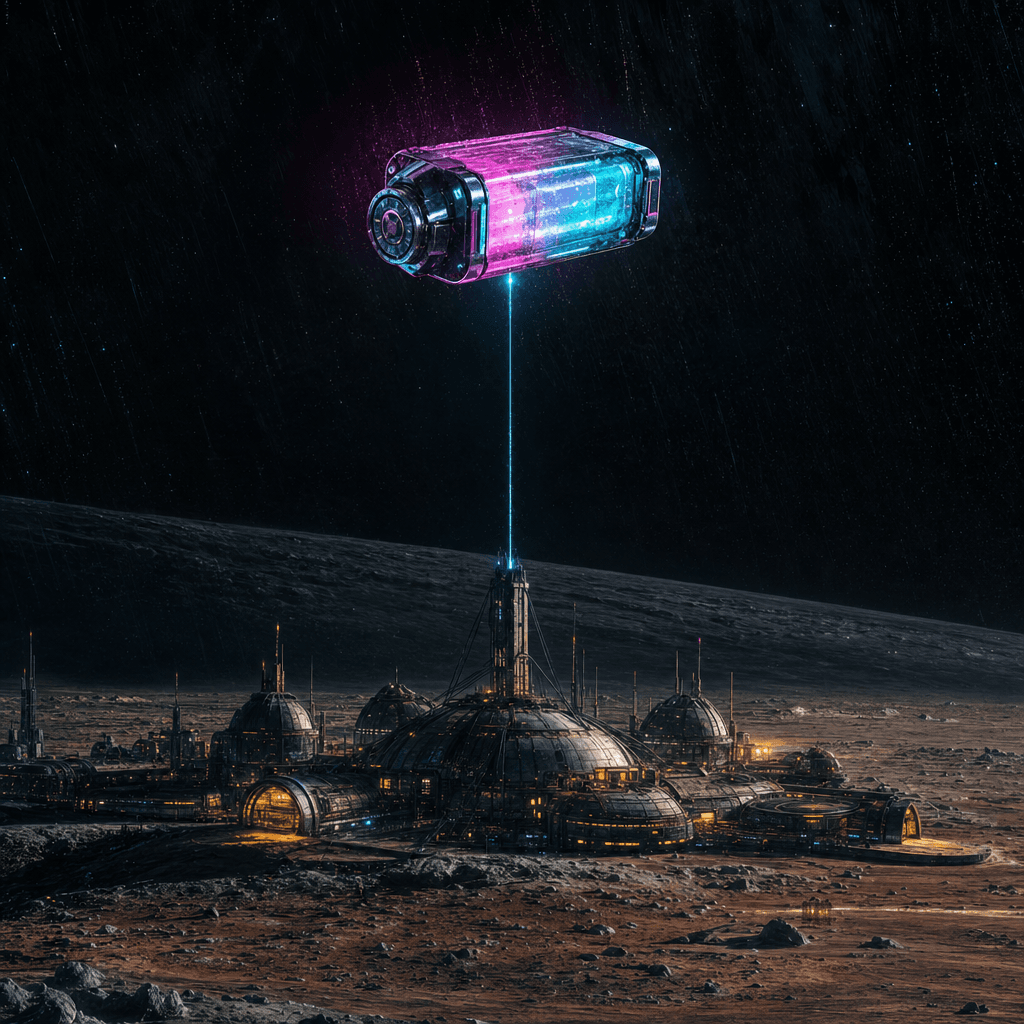
Tritium betavoltaic cells — nuclear "batteries" that convert electrons from radioactive decay directly into electricity — are being tested in space for the first time, and the implications for lunar surface power are worth tracking closely on your roadmap.
What exactly is a tritium betavoltaic cell, and why does it matter for the Moon?
A betavoltaic cell works like a photovoltaic cell, except the energy source is not sunlight but beta particles (electrons) emitted by a radioactive isotope — in this case tritium, a hydrogen isotope with a half-life of approximately 12.3 years. The device has no moving parts, no thermal cycling risk, and no dependence on a solar flux that drops to zero during the lunar night. As IEEE Spectrum explains, these cells are designed to survive the long, bitterly cold lunar nights — periods that last roughly 354 hours and push surface temperatures below –170 °C — with ease. That single sentence is the core finding this week: tritium betavoltaic cells are now in orbital testing as a candidate continuous-power source for lunar surface installations that cannot rely on solar input alone.
This sits squarely in the power ON worlds beat. Artemis surface power planning has so far centred on two architectures: solar arrays paired with regenerative fuel cells or batteries, and fission surface power (FSP) systems targeting 10 kWe at Technology Readiness Level (TRL) 5 by the late 2020s. Betavoltaics occupy a different niche — low but truly uninterrupted power density, suited to keeping sensors, communications nodes, and life-support monitors alive rather than running electrolysers or rovers. The orbital test is the first step on the demo→deployment curve; it proves survivability in the space radiation environment, but it does not yet prove adequate power density for crew-scale loads.
What power levels can betavoltaics actually deliver, and what gap remains?
Here is where the economics get honest. Betavoltaic power density is low — current tritium-based devices are typically measured in microwatts to low milliwatts per cubic centimetre, orders of magnitude below what a fission reactor or even a modest solar array delivers per kilogram. IEEE Spectrum notes the orbital test is positioned as support for future lunar bases, implying an enabling rather than a primary-power role. The pathway from this orbital demo to a bankable surface power node will require either a substantial jump in cell efficiency or aggregation into larger arrays — neither of which has yet been demonstrated at lunar-relevant scale.
For context, NASA's Fission Surface Power (FSP) project targets 10 kWe continuous output from a single reactor unit, with a mass target that keeps specific power competitive with large solar arrays in permanently shadowed or high-latitude sites. Betavoltaics as currently demonstrated would need roughly three to four orders of magnitude improvement in delivered watts-per-kilogram to compete directly. That is not a reason to dismiss the technology — it is a reason to size expectations correctly.
Where this orbital test sits on the maturity curve
The first-ever space test of tritium betavoltaics is a TRL 6 milestone in progress: a prototype demonstrated in a relevant space environment. What it does not yet demonstrate is: (1) power output at lunar surface temperatures under operational load, (2) integration with a surface power distribution architecture, or (3) a supply chain for tritium at the quantities a multi-node lunar base would require. Tritium is a controlled substance produced primarily as a byproduct of fission reactors, and global production is measured in kilograms per year — a constraint that will shape procurement strategy long before launch costs do.
The parallel development worth watching: IEEE Spectrum (ongoing) reports that these cells could support human habitation scenarios specifically because of their cold-weather resilience. If the orbital test validates radiation hardness and confirms projected output curves, the next decision point is whether a lunar surface demonstrator — likely co-manifested with an Artemis logistics mission — can be funded and integrated before the mid-2030s crew habitation phase.
For your next decision: If you are evaluating surface power architectures for lunar commercial or agency missions, betavoltaics now have an orbital data point you did not have last month. They will not displace fission or large solar arrays for primary loads, but as a watchkeeper power source for distributed sensor nodes and dormancy-mode life support, the continuous-output profile is genuinely differentiated. The question is whether the orbital test produces efficiency numbers that justify inclusion in a 2028–2032 surface payload manifest.
Created with AI assistance. Editorial oversight: Juergen Ritzek. See our AI disclosure.