Briefing · October 28, 2026
Tritium Batteries and Lava Tubes: The Unglamorous Physics Behind Lunar Surface Power
Two overlooked lunar power stories — nuclear betavoltaic cells and lava-tube siting — reframe what "sustained presence" actually demands from engineers.
What Is Actually Limiting Power on the Lunar Surface Right Now?
The lunar night lasts approximately 14 Earth days, and surface temperatures during that period plunge to roughly −173 °C — conditions that kill conventional photovoltaic (PV) systems and drain chemical batteries long before sunrise returns. That single constraint is the governing engineering problem for any sustained human or robotic presence on the Moon, and two recent developments deserve side-by-side scrutiny from anyone building a lunar power roadmap.
The first is betavoltaic nuclear batteries using tritium, now being tested in space for the first time: a tritium betavoltaic cell converts the low-energy beta particles emitted by radioactive tritium decay directly into electrical current via a semiconductor junction — the same physical principle as a solar cell, but driven by nuclear decay rather than photons, meaning it operates continuously regardless of sunlight or temperature. IEEE Spectrum (2026-10-01) reports that these cells are targeting lunar base applications, where their key advantage is surviving the 14-day night with no moving parts, no thermal management overhead, and no dependence on a solar window. The devices are compact enough to integrate into a CubeSat-scale demonstration currently in orbit, placing them at roughly Technology Readiness Level (TRL) 5–6 for the space environment — a meaningful step, but still well short of the TRL 8–9 needed for a crewed surface deployment.
The honest caveat: tritium betavoltaics produce power densities measured in microwatts to milliwatts per cubic centimeter in current form. They are not a primary power source for a habitat; they are a keep-alive power source for sensors, clocks, and low-draw electronics during lunar night. Anyone modeling a lunar outpost who conflates "survives the night" with "powers the base" is using the wrong architecture.
Could Lava Tubes Reduce the Surface Power Requirement Entirely?
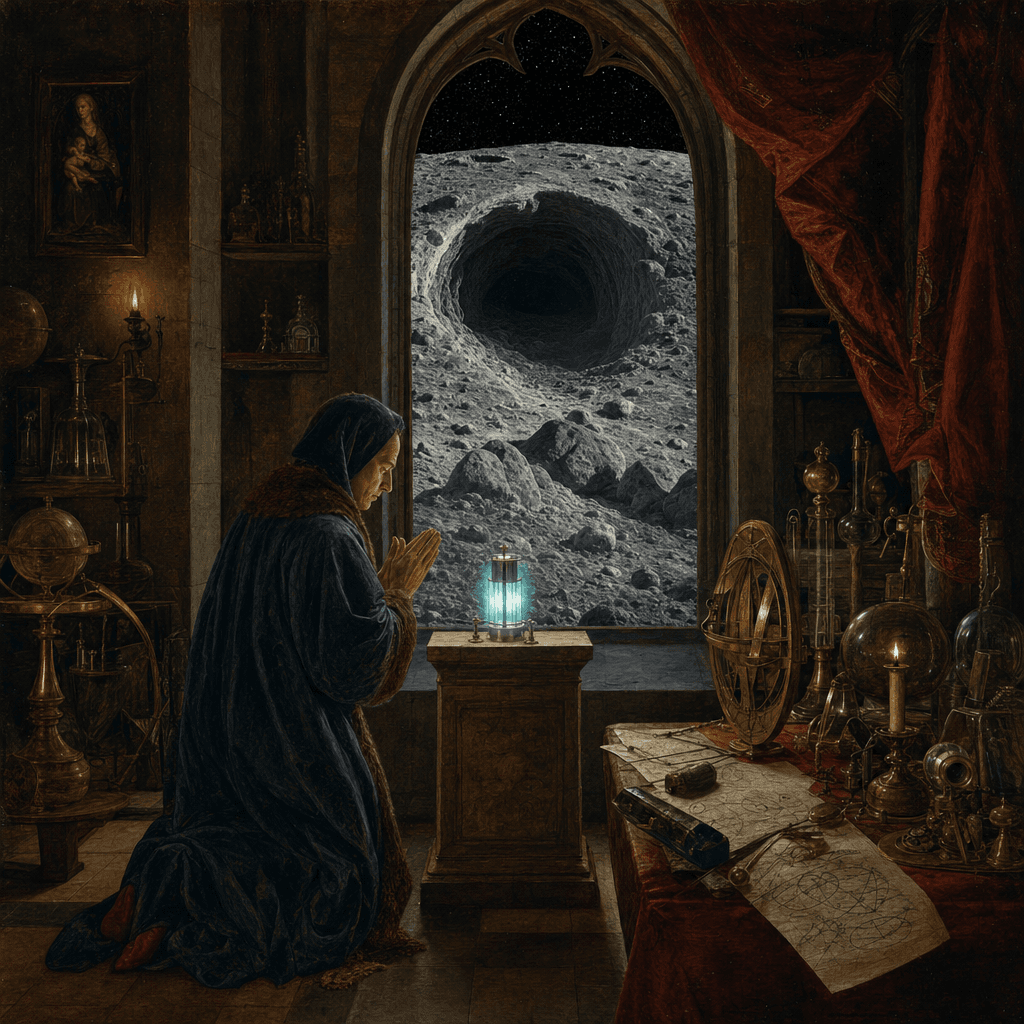
The second development reframes the problem from the siting side. IEEE Spectrum (2026-10-01) covers NASA's Artemis-linked GIMLI mission concept, which targets lunar lava tubes — subsurface voids created by ancient volcanic activity — as candidate habitation sites. The thermal logic is directly relevant to power budgets: lava tube interiors maintain temperatures near −20 °C year-round, compared to surface swings from +120 °C to −173 °C. A habitat sited underground would require dramatically less thermal control power, which is typically one of the largest continuous loads on a lunar surface system.
The GIMLI concept is still a mission study, not a funded flight — it sits at the proposal stage, meaning the lava-tube-as-habitat idea has not yet cleared the hurdle of a confirmed launch manifest or budget line. What it does do is sharpen the requirements question for power architects: if subsurface siting halves the thermal load, does the sizing case for a large fission surface power unit change materially? That is a calculation lunar power program managers should be running now, before hardware commitments lock in assumptions based on open-surface siting.
How Do These Two Developments Fit the Broader Artemis Power Architecture?
NSS (2026-10-23) reports that NASA Administrator Jared Isaacman and Associate Administrator Amit Kshatriya outlined an accelerated Artemis roadmap in October 2026, with Artemis Program Manager Jeremy Parsons detailing mission plans and technical challenges. The revised course explicitly prioritizes sustained lunar presence over flags-and-footprints missions — which means the surface power question is no longer a back-of-envelope exercise but a near-term procurement decision.
NASA's Fission Surface Power (FSP) project targets a 10 kW electric (kWe) demonstration unit on the lunar surface in the late 2020s, contracted to Lockheed Martin, BWX Technologies, and partners. Betavoltaic cells and lava-tube siting are not competitors to that system — they are complementary layers. A 10 kWe fission reactor handles primary loads; betavoltaics handle keep-alive and distributed sensing; lava-tube siting reduces the thermal load the entire stack must manage. The risk is that each layer is being developed on a different funding track, with integration architecture undefined.
The Decision That Cannot Wait
For program managers and investors tracking lunar surface power: the betavoltaic-in-orbit demonstration and the GIMLI lava-tube siting study are both low-cost signals worth monitoring closely. Neither requires a large capital commitment to track, but both will inform the sizing assumptions that do require large capital commitments — specifically, whether the FSP unit at 10 kWe is correctly sized, or whether a modular, lower-power architecture combining fission, betavoltaic keep-alive, and subsurface thermal shielding is the more defensible design for the 2030s outpost scenario that the revised Artemis roadmap is now accelerating toward.
Created with AI assistance. Editorial oversight: Juergen Ritzek. See our AI disclosure.