Briefing · November 28, 2026
The Physics Wall That AI Data Centers in Orbit Cannot Climb Around
A NASA JPL physicist's preprint puts hard numbers on why orbital AI computing faces brutal solar power and heat-rejection limits.
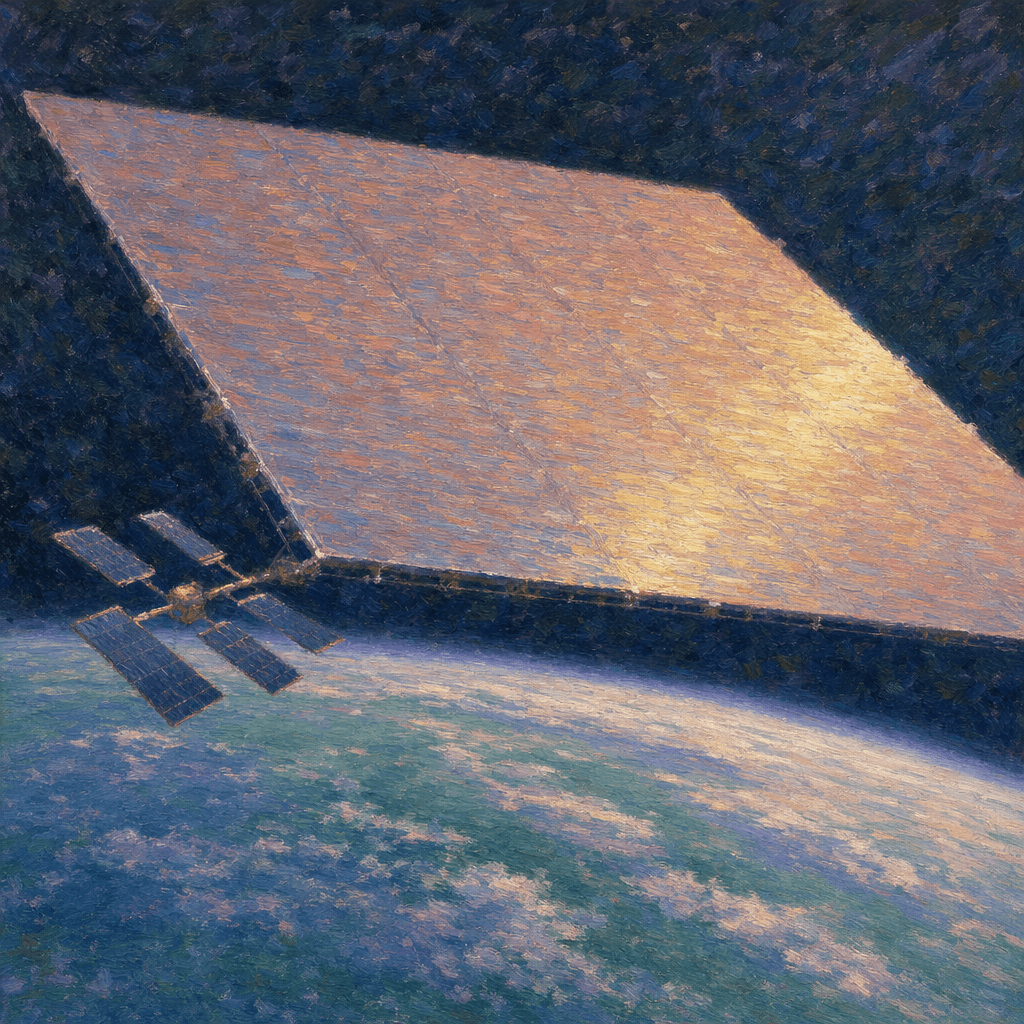
What does the physics actually say about power in orbit?
Space-based solar power (SBSP) advocates have long argued that the constant sunlight of low Earth orbit (LEO) makes it the ideal home for energy-hungry computing. A new preprint from Dr. Slava Turyshev of NASA's Jet Propulsion Laboratory (JPL) puts a sharp number on the ceiling — and it is far lower than the business plans of several orbital data-center startups assume. According to Turyshev's analysis, the hard constraint is not the solar collection area but the ability to reject waste heat: in the vacuum of space, radiation is the only mechanism available, and current radiator technology limits practical power densities to levels that cannot support hyperscale AI workloads in orbit as of late 2026.
The self-contained finding that matters for anyone building a roadmap: Dr. Slava Turyshev of NASA JPL concluded in a 2026 preprint that orbital AI data centers are constrained not by sunlight availability but by the thermodynamic impossibility of rejecting enough waste heat with radiator masses achievable under current launch economics, according to Universe Today (2026-11-26).
Why is heat rejection the binding constraint, not solar panel area?
Radiative cooling — the mechanism by which a spacecraft dumps waste heat — works by emitting infrared radiation into the cold of space. On Earth, data centers rely on convective cooling: air or water carries heat away. In orbit, that option does not exist. Every watt of compute power generates waste heat that must leave the spacecraft as infrared photons, requiring large, flat radiator panels. The mass penalty for those radiators compounds quickly: more compute means more solar panels to supply power, which means more waste heat, which means still more radiator area, all of which must be launched at today's prices.
Universe Today (2026-11-26) reports that Turyshev's paper — available in preprint on arXiv — identifies this radiator scaling problem as the reason back-of-the-envelope calculations underpinning several orbital computing business plans are, in his framing, dangerously optimistic. The analysis does not say orbital computing is impossible; it says that the specific power (watts per kilogram) and specific cooling (watts per square meter of radiator) assumptions embedded in current proposals have not been demonstrated at scale in any orbital environment as of 2026.
What does the servicing challenge add to the cost picture?
A second Universe Today piece tightens the vise further. Universe Today (2026-11-27) notes that any orbital data center will require on-orbit servicing to swap failed components — GPUs, power converters, solar arrays — and that human astronaut visits are prohibitively expensive for routine maintenance. The proposed solution is robotic servicing, but no robotic system in 2026 has demonstrated the dexterity and reliability needed to swap rack-mounted compute hardware in a pressurized or unpressurized orbital module at the cadence a commercial data center would require. NASA's Dextre robot on the International Space Station (ISS) is the closest operational analog, and it was designed for a very different task profile.
For the space solar community specifically, this matters in two ways. First, the solar arrays powering an orbital data center are part of the servicing problem: degraded panels in LEO lose roughly 1–3% of efficiency per year due to atomic oxygen erosion and particle radiation, so a facility expecting a 10-year operating life cannot simply install arrays and walk away. Second, every kilogram dedicated to radiators and service robots is a kilogram not dedicated to the photovoltaic (PV) arrays and power-conditioning electronics that deliver value. The mass budget is a zero-sum competition.
What this means for your next decision
None of this forecloses the orbital data-center concept. It does, however, place it firmly at Technology Readiness Level (TRL) 2–3: basic physics understood, no hardware demonstrations at relevant scale, no validated cost model. Investors and program officers evaluating proposals in this space should require three numbers before proceeding: demonstrated specific power of the solar subsystem (W/kg, in orbit, not laboratory), demonstrated radiator rejection capacity (W/m², in orbit), and a credible robotic servicing cost per maintenance event. Any proposal that cannot supply all three with orbital heritage data is selling a physics assumption, not a product. The Turyshev preprint is a useful, citable benchmark for exactly that due-diligence conversation.
Created with AI assistance. Editorial oversight: Juergen Ritzek. See our AI disclosure.