Briefing · November 6, 2026
The Moon Race Has a Power Problem: What NASA's 2028 Timeline and China's 2030 Bid Mean for Lunar Surface Energy
With NASA targeting 2028 and China aiming for 2030, the lunar surface power gap is no longer a distant engineering problem — it's a live procurement decision.
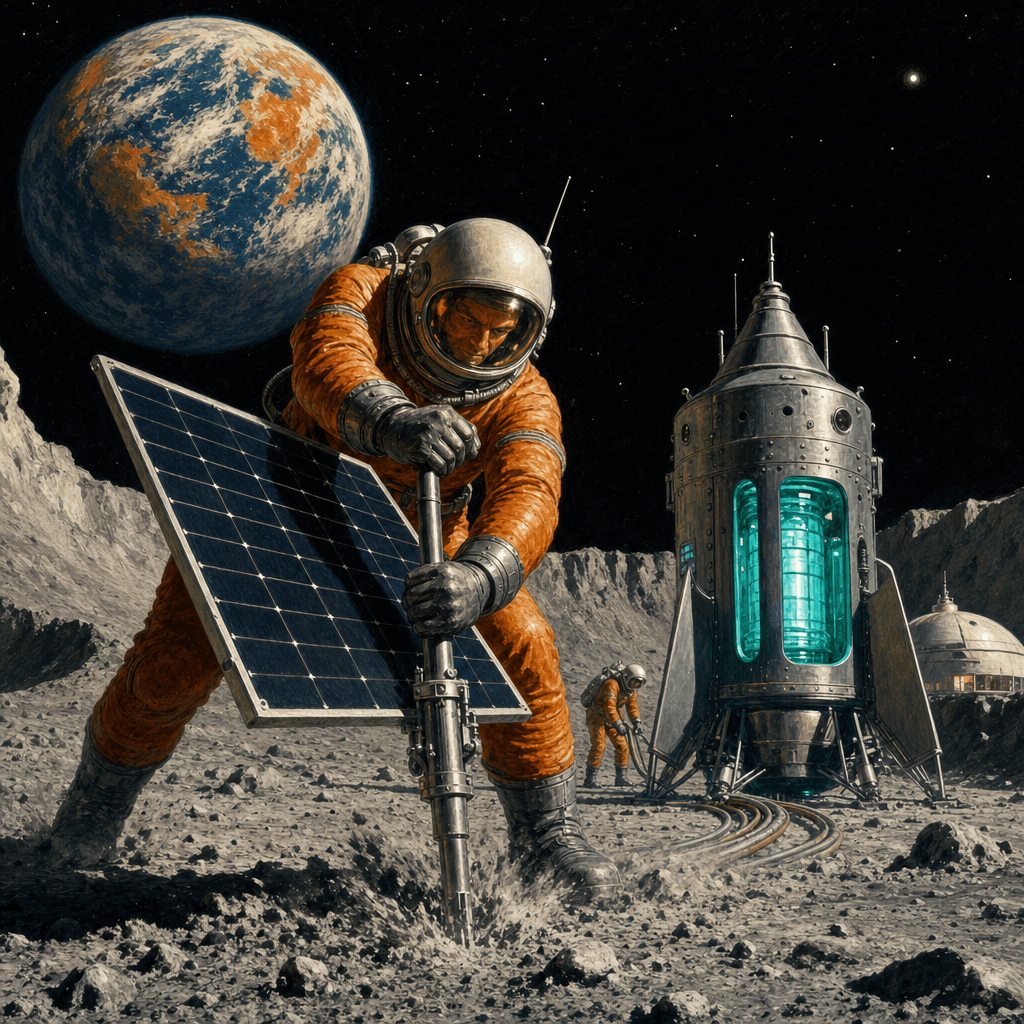
What is driving the sudden urgency on lunar surface power?
Two crewed Moon programs are now on converging timelines, and neither has a fully funded, flight-proven surface power system. NASA confirmed in October 2026 that it is targeting an Artemis III test flight in 2027 and an Artemis IV crewed lunar surface mission in 2028 — the first American boots on the Moon since Apollo 17 in December 1972. Separately, China's Wang Xiang, deputy chief designer of China's crewed space program, publicly detailed on November 3, 2026 a "two launches, lunar orbit rendezvous" architecture using the Long March-10 rocket, the Mengzhou crew spacecraft, and the Lanyue lunar lander, with a target crewed landing date before 2030. Both nations have named hardware. Neither has named a kilowatt-hour budget for sustained surface operations.
The core finding, stated plainly: Two independent crewed lunar programs — one targeting 2028, one targeting 2030 — are advancing mission architectures in which surface power generation and storage remain below Technology Readiness Level (TRL) 6, creating a critical gap between announced timelines and deployable energy infrastructure.
What does "surface power" actually mean for a crewed lunar mission?
Surface power for the Moon refers to the generation, storage, and distribution of electrical energy directly on the lunar surface to support life support, thermal management, communications, and science payloads. Solar photovoltaic (PV) arrays are the primary generation technology under consideration for equatorial and mid-latitude sites, supplemented by small fission reactors such as NASA's Fission Surface Power project for the permanently shadowed polar regions where sunlight is unavailable for up to 14 Earth days at a time. TRL 6 means a system has been demonstrated in a relevant environment — for lunar surface power, that means a vacuum-compatible, radiation-hardened, regolith-dust-tolerant prototype, not a lab bench at standard atmosphere. No PV or fission system for lunar surface use has yet completed a lunar-environment demonstration as of November 2026.
How wide is the gap between NASA's schedule and its power readiness?
NASA's October 2026 acceleration update describes a path to 2028 crewed surface operations but does not specify a kilowatt allocation for the initial Artemis III sortie mission, which is a short-duration surface stay. For that mission, suit and lander power budgets are managed by the Human Landing System provider, not by a separate surface power infrastructure contract. The gap opens wider for Artemis IV and beyond, when outpost-class power — estimates from prior NASA studies suggest 10 kilowatts (kW) continuous as a minimum for a two-person habitat — becomes necessary.
Meanwhile, government spending on civil space activities reached $42.6 billion USD in fiscal year 2026, yet the share allocated specifically to lunar surface power infrastructure has not been broken out as a named line item in publicly available budget documents. That invisibility in the budget is itself a signal: surface power is still being treated as a subsystem of lander or habitat contracts rather than as a standalone infrastructure procurement, which means no single program office is accountable for delivering operational watts to the surface on the 2028 timeline.
China's architecture adds competitive pressure but not answers
China's two-launch rendezvous architecture is elegant from a mass budget perspective — separating the crew vehicle from the lander reduces the payload each Long March-10 must carry — but it also constrains how much surface power hardware can fly on the first crewed missions. China has not published specific power budgets for the Lanyue lander's surface operations phase. The competitive dynamic is real: a Chinese crewed landing before or alongside Artemis IV would reframe international negotiations over lunar south pole resource zones and power infrastructure placement, particularly given that high-elevation crater rims near the south pole offer near-continuous solar illumination and are already claimed as preferred landing zones by both programs.
What should power and space program decision-makers do now?
The implication is narrow and actionable. If you are evaluating partnerships or R&D investment in lunar surface power — PV arrays designed for 1/6-g deployment, dust-mitigation coatings, or low-mass battery and fuel-cell storage — the competitive window is not 2030. Procurement decisions that can influence Artemis IV hardware manifests are being made in 2026 and early 2027. The programs that arrive at those conversations with TRL 6 hardware demonstrated in a relevant environment, specific mass-per-watt numbers, and a dust-tolerance data package will be on the manifest. Those that arrive with promising lab results will not.
Created with AI assistance. Editorial oversight: Juergen Ritzek. See our AI disclosure.