Briefing · September 19, 2026
Starship's First Orbital Attempt Is the Launch Cost Test Space Solar Has Been Waiting For
SpaceX's IFT-14 orbital flight attempt could reshape the economics that have blocked space-based solar power for decades.
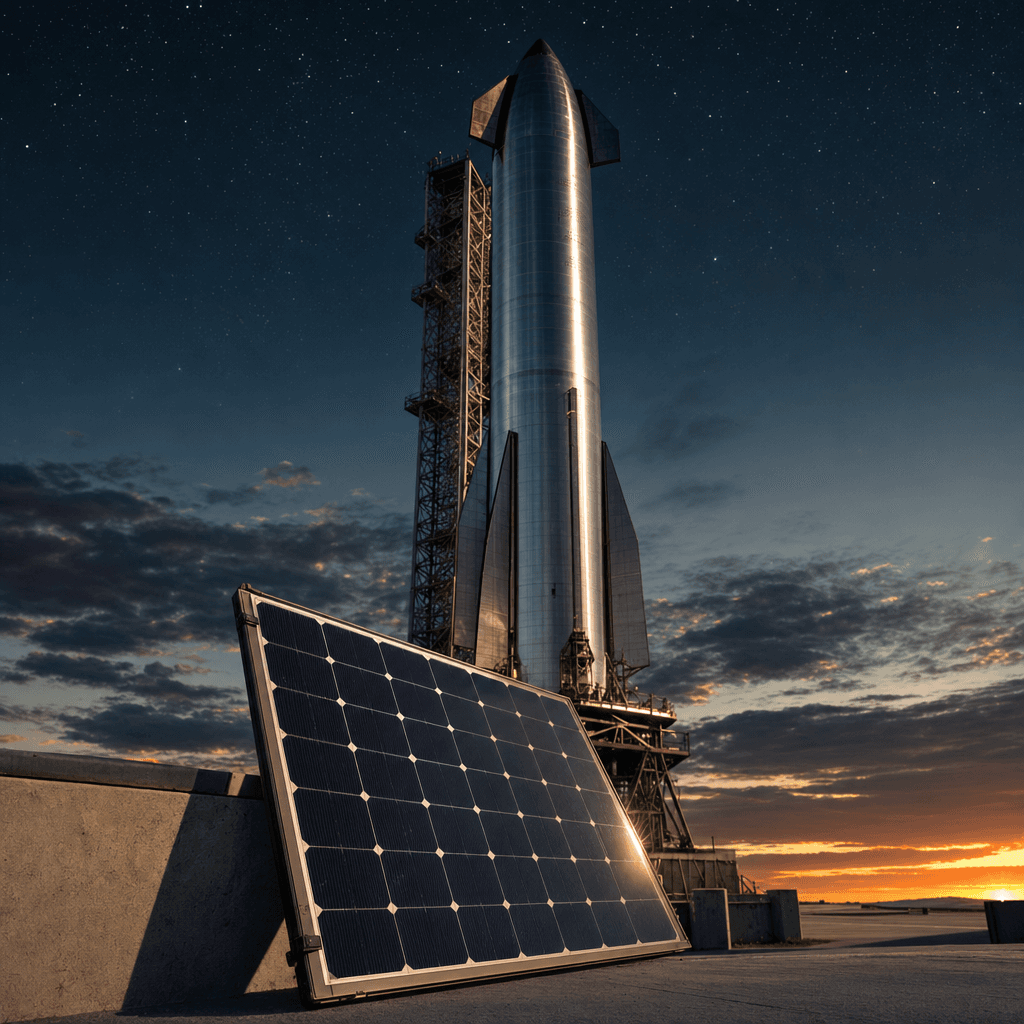
What Is Actually Happening With Starship IFT-14?
SpaceX is preparing Integrated Flight Test 14 (IFT-14), the first attempt to place Starship into orbit, pending regulatory approval, as confirmed by Space Policy Online (2026-09-17). To be precise about where this sits on the demo-to-deployment curve: IFT-14 would prove orbital insertion capability, not commercial payload delivery, not reusability at cadence, and certainly not the per-kilogram launch price that space-based solar power (SBSP) business cases require. But it is the necessary first gate.
Space-based solar power (SBSP) is the concept of collecting sunlight in geostationary orbit — where a satellite is illuminated roughly 99% of the time versus ~15–20% for a ground-based panel — converting it to microwave or laser energy, and transmitting it to a rectenna on Earth. The concept has been technically plausible since the 1970s; the blocker has always been launch economics. Every credible SBSP architecture requires lifting thousands of tonnes to geostationary Earth orbit (GEO), and today's launch costs make that commercially insolvent.
Does Starship Actually Change the Launch Cost Math?
That is the right question, and the honest answer is: potentially, but only at a verified cadence and reusability rate that does not yet exist. The IFT-14 attempt, if successful, would demonstrate that Starship can reach orbit — a prerequisite for every subsequent cost-reduction claim. Nothing in the publicly available regulatory filings or flight manifests confirms a per-kilogram price to GEO that matches the figures SBSP architects need.
What IFT-14 does change is the credibility timeline. A successful orbital insertion shifts Starship from a high-altitude suborbital test article to a vehicle approaching the technology readiness level (TRL) needed for payload manifesting. For SBSP program officers at the European Space Agency (ESA) SOLARIS initiative and for commercial power-beaming startups currently sizing their first demonstration satellites, that milestone matters — not because costs drop overnight, but because the vehicle procurement risk profile changes.
The ESA IRIS² Signal Worth Watching in Parallel
The same week as the Starship announcement, SatNews (2026-09-17) reported that ESA signed 18 contracts with 80 industrial partners to advance the next-phase IRIS² low-Earth orbit (LEO) communications constellation architecture. IRIS² is a connectivity programme, not an SBSP programme, but the industrial mobilisation it represents is directly relevant to anyone watching European space solar ambitions.
Here is why: the 80-partner industrial base being assembled for IRIS² overlaps substantially with the antenna, power management, and large-structure manufacturing supply chains that ESA SOLARIS would need for an SBSP demonstration. Contracts that build LEO satellite manufacturing capacity in Europe in 2026 reduce the industrial risk premium on a future SBSP demonstration mission. ESA has not publicly priced SOLARIS deployment, but analysts tracking the programme cite the need for specific power figures above 1,000 W/kg at the array level — a target no fielded system has yet achieved — before GEO delivery costs become secondary.
What the Starship Orbital Milestone Does Not Prove
It is worth being explicit. A single orbital insertion flight does not prove: (1) booster reusability at the 100-flight cadence that drives per-kilogram cost projections below USD 100/kg to LEO; (2) upper-stage reuse, which is required for the most aggressive cost curves; or (3) fairing or cargo volume utilisation at the scale SBSP architectures assume. The gap between "reached orbit once" and "bankable launch infrastructure for a multi-gigawatt SBSP programme" remains measured in years and billions of dollars of further investment.
Programme officers evaluating SBSP roadmaps in late 2026 should treat IFT-14 success as a gate-opening event, not a cost-reduction event. It clears the path for the next set of proof points — payload delivery, booster catch and refly, on-orbit propellant transfer — each of which narrows the uncertainty band on launch cost assumptions that underpin every SBSP financial model.
The Decision Facing SBSP Investors and Programme Officers Right Now
If you are sizing a power-beaming demonstration satellite for the early 2030s, IFT-14's outcome this week directly affects your launch vehicle shortlist and your contingency budget. A successful orbital flight keeps Starship on the manifest as a credible option; a failure or extended regulatory delay extends the window in which legacy heavy-lift pricing governs your business case. Watch the Space Policy Online (2026-09-17) regulatory approval status closely — the IFT-14 flight date is not yet fixed, and a slip of even one quarter shifts programme critical paths for at least three known European and American SBSP demonstrator teams.
The most important number this week is not a watt or a kilogram-per-kilowatt — it is whether IFT-14 achieves orbit, because that single binary outcome sets the credibility floor for every launch cost assumption in your next board deck.
Created with AI assistance. Editorial oversight: Juergen Ritzek. See our AI disclosure.