Briefing · October 1, 2026
Starship Reaches Orbit and Swift Stalls: Two Data Points That Define In-Space Power's Near-Term Ceiling
SpaceX's first orbital Starship and NASA's failed Swift reboost mission set hard boundary conditions for space-based solar power economics in 2026.
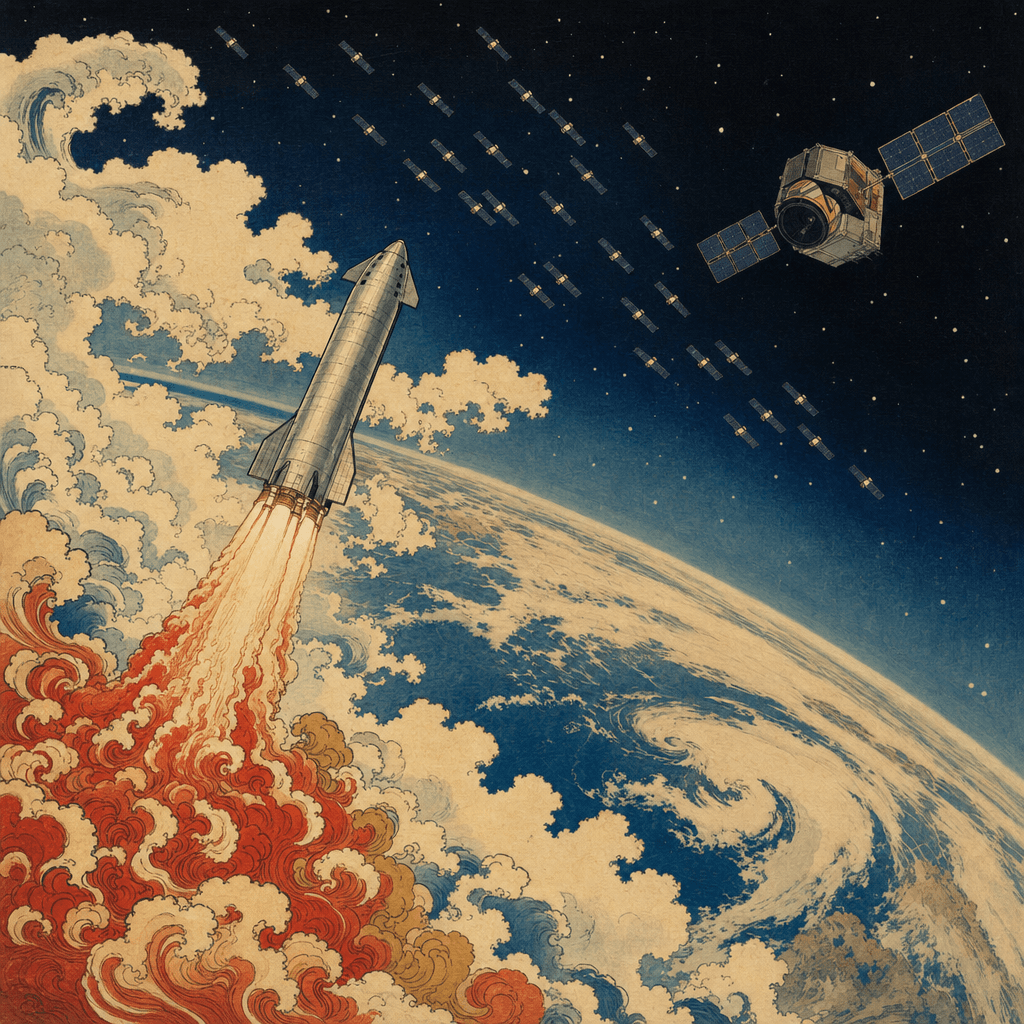
Two milestones landed in the same news cycle this week, and read together they define the near-term ceiling — and the floor — for anyone pricing a space-based solar power (SBSP) architecture right now: SpaceX's Starship finally reached orbit, and NASA's Swift observatory reboost mission concluded without raising the spacecraft's orbit by a single kilometre.
SpaceX's Starship Integrated Flight Test-14 reached Earth orbit for the first time, deploying 26 operational Starlink V3 satellites in the process — a launch-cost milestone that every SBSP program manager has had pencilled in as the unlock condition for economic viability. The flight did not go exactly as planned, but orbital insertion is orbital insertion: the vehicle crossed the threshold that matters for payload pricing discussions. SpacePolicyOnline (2026)
What does Starship's first orbital flight actually prove for SBSP?
Reaching orbit proves propulsion and trajectory — not reusability cadence, not fairing volume at scale, and not the per-kilogram price that SBSP architectures need to close their business cases. Analysts have long pegged the viable launch-cost threshold for SBSP at roughly 200–500 USD per kilogram to geostationary transfer orbit; Starship's stated target is in that range, but a single orbital test flight does not validate a price. It validates a vehicle. The distinction matters enormously: you can model future launch economics on this flight, but you cannot yet contract them.
For SBSP programme officers, the practical implication is that Starship's first orbital success is a go/no-go gate on Phase 1 business-case modelling — it keeps the door open — but specific power (W/kg) of the solar array, end-to-end transmission efficiency, and rectenna siting costs remain the binding constraints on whether any architecture closes financially. One orbital flight does not move those numbers.
What does the Swift reboost failure mean for in-space servicing?
The second data point is, in some ways, more instructive. A commercial mission contracted to boost NASA's Swift observatory concluded without raising the spacecraft's orbit, yet NASA (2026) framed the outcome explicitly as a lessons-learned exercise that will benefit future in-space servicing programs. That framing is significant: the agency is treating a mission that did not meet its primary objective as infrastructure for the next attempt, not as a programme cancellation event.
In-space servicing, assembly, and manufacturing (ISAM) is the enabling technology layer beneath orbital solar power — you cannot maintain, upgrade, or expand a gigawatt-scale SBSP constellation without it. The Swift mission sits at Technology Readiness Level (TRL) 6 territory for commercial reboost: system demonstrated in a relevant environment, but not yet reliable enough to be contractually bankable. Every SBSP roadmap that assumes on-orbit assembly or servicing needs to account for exactly this gap.
Plain-language explainer: Space-based solar power works by placing large photovoltaic arrays in orbit — typically geostationary orbit at roughly 35,786 km altitude — where sunlight is available nearly 24 hours a day, then converting that electricity to microwave or laser energy and transmitting it to a receiving antenna (rectenna) on Earth's surface. The key engineering challenge is not the physics of wireless power transfer, which has been demonstrated in the laboratory; it is building arrays with high enough specific power (watts generated per kilogram of hardware launched) and low enough total launch cost to undercut terrestrial solar-plus-storage on a levelised cost of energy basis.
What should programme managers do with these two data points?
Use Starship's orbital success to update your launch-cost assumptions in scenario modelling — move the "Starship-class launch available" milestone from speculative to probable — but do not retire the launch-cost risk line entirely until a reusable flight cadence is demonstrated at commercial rates. Simultaneously, the Swift reboost outcome should prompt any SBSP programme with an ISAM dependency to stress-test that dependency: if your Phase 2 architecture assumes on-orbit servicing is available by a given year, the Swift experience suggests you should build in at least one additional development cycle.
The week's data does not change the fundamental SBSP calculus: high specific power arrays, affordable heavy-lift, reliable wireless power transfer, and in-space assembly must all mature in parallel. What changed is that one of those four variables — launch vehicle capability — moved meaningfully forward, while the servicing variable delivered a frank reminder that "demonstrated in a relevant environment" and "operationally reliable" are not the same address on the TRL scale.
Plan accordingly.
Created with AI assistance. Editorial oversight: Juergen Ritzek. See our AI disclosure.