Briefing · November 19, 2026
Space Force's $10M SEWOL Contracts Signal Real Momentum for In-Space Power Beaming
The U.S. Space Force awarded $10M in SEWOL prototype contracts to three firms in November 2026, marking the clearest government commitment yet to orbital power transfer.
What Did the Space Force Just Fund — and Why Does It Matter?
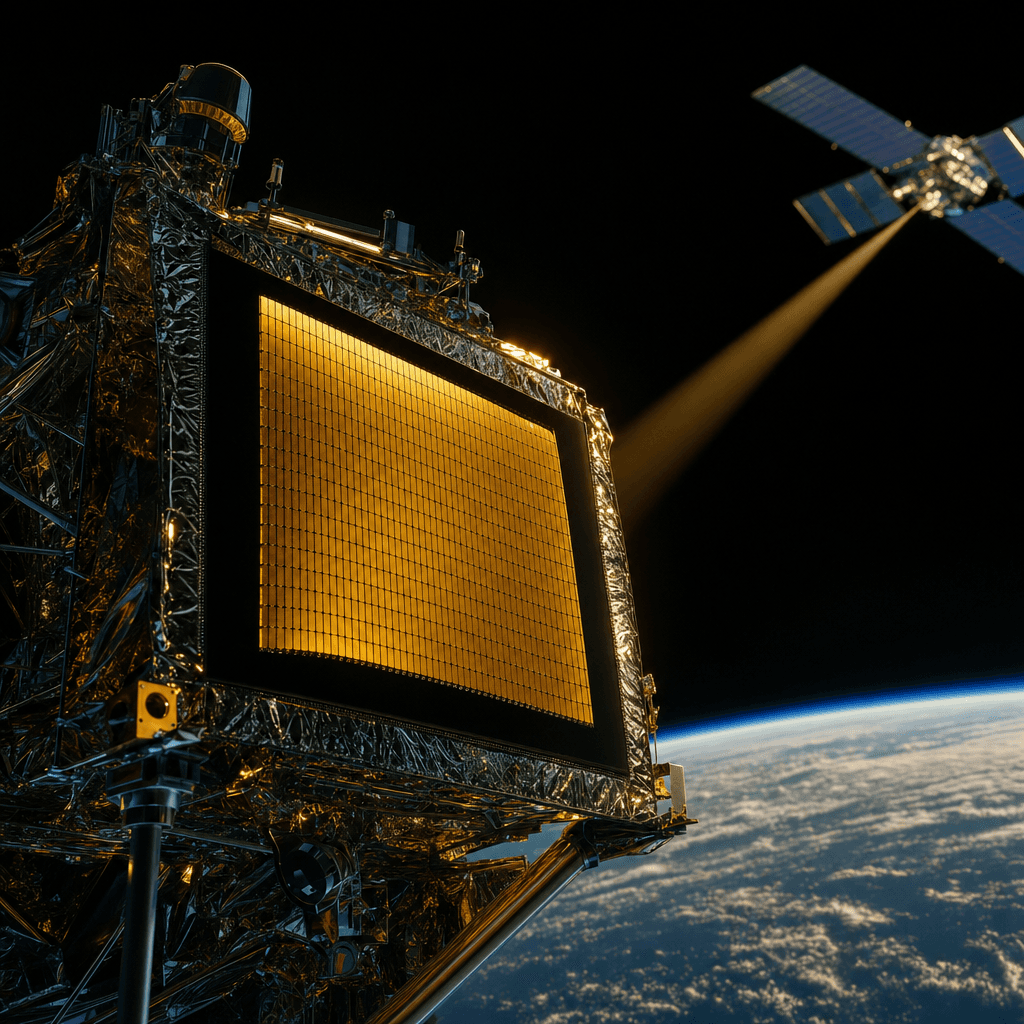
The U.S. Space Force awarded $10 million USD in combined first-phase Space Energy and Wireless Operations and Logistics (SEWOL) prototype contracts to three firms in November 2026, making it the most concrete government procurement signal yet that power-beaming infrastructure for in-space operations is moving from laboratory concept to funded prototype. The Space Force SEWOL award (2026-11-16) does not build a power plant — it buys the first hardware demonstrations that will inform whether a scalable orbital energy transfer architecture is feasible at program-of-record cost.
That distinction matters. Space solar has a long history of funded studies that never produce a watt of delivered power. What separates SEWOL from the prior generation of paper studies is that contracts are going to firms building prototype hardware, not writing reports. The $10 million USD figure is modest — roughly the cost of a single rideshare slot on a medium-lift vehicle — but the structure of a phased prototype competition signals that the Space Force intends to downselect and scale, not simply collect white papers.
What Is Wireless Power Transfer in Space, and What Does SEWOL Actually Test?
Wireless power transfer (WPT) in space works by converting electrical power — generated by solar arrays or a nuclear source — into microwave or laser radiation, transmitting that beam across a distance, and reconverting it into usable electricity at a receiver. The efficiency of each conversion step compounds: a system achieving 85% DC-to-RF conversion, 90% free-space transmission, and 80% RF-to-DC rectification delivers roughly 61% end-to-end — well above what current tether or proximity operations can achieve for certain orbital geometries, but far below what a cable delivers. SEWOL is specifically focused on the in-space segment: transferring power between spacecraft or from an orbital asset to a lunar or deep-space platform, not transmitting energy to Earth's surface.
That scope is deliberate. Power TO Earth (terrestrial space-based solar power) requires gigawatt-scale arrays and a resolved regulatory path for ground-based rectennae. Power IN space — supplying a space station, a lunar gateway node, or a constellation of sensors — requires kilowatt-to-megawatt scale WPT with demonstrated pointing accuracy and thermal management. SEWOL lives in the second category, which has a shorter path to a fielded system and a defensible military use case: logistics independence for cislunar operations.
How Does This Fit the Broader Power-ON-Worlds Picture?
The timing is not coincidental. Canadian lunar rover teams — Canadensys, MDA Space, and Mission Control — are completing Phase 0 lunar utility rover studies for Artemis and signaling readiness for an earlier-than-planned launch (2026-11). Rovers that can't generate or receive power are stranded assets during the 14-day lunar night. A demonstrated WPT architecture — even at the 1–10 kW scale SEWOL prototypes are likely to target — would directly extend the operational envelope of any surface asset that cannot carry a nuclear source.
Speaking of nuclear: Space Nuclear Power Corp. (SpaceNukes) opened its Manufacture and Materials Development Facility in Los Alamos, New Mexico on November 13, 2026, specifically to produce next-generation space fission reactors, per SpaceNews (2026-11-16). WPT and compact fission are complementary, not competing: a reactor that can beam power to a rover or a distant spacecraft eliminates the mass penalty of running power cable across kilometers of regolith. The two programs maturing in parallel in late 2026 suggest a coherent, if loosely coordinated, U.S. government push toward cislunar power infrastructure.
What Should You Watch for Next?
Three things will determine whether SEWOL graduates from $10 million USD prototype to a bankable program. First, demonstrated pointing stability: a WPT system that can't hold beam lock on a moving receiver in the presence of orbital perturbations is a lab result, not a system. Second, specific power of the transmitter array — the watts-per-kilogram figure will determine whether the architecture is launch-cost-competitive with simply flying more batteries. Third, the Phase 2 downselect: if the Space Force reduces from three contractors to one and increases the contract value by an order of magnitude, that is the moment SEWOL becomes a program worth tracking on your roadmap.
Investors and program officers evaluating power-beaming startups should map their technology against those three criteria before the Phase 2 solicitation lands — because the firms that can answer all three with hardware data, not simulations, are the ones that will advance.
Created with AI assistance. Editorial oversight: Juergen Ritzek. See our AI disclosure.