Briefing · August 7, 2026
Silicon PV for Satellites: Fraunhofer ISE and Source Energy Challenge III-V Dominance
Fraunhofer ISE and Source Energy are developing silicon-based PV modules for satellites, targeting a lower-cost alternative to III-V cells that dominate spacecraft power today.
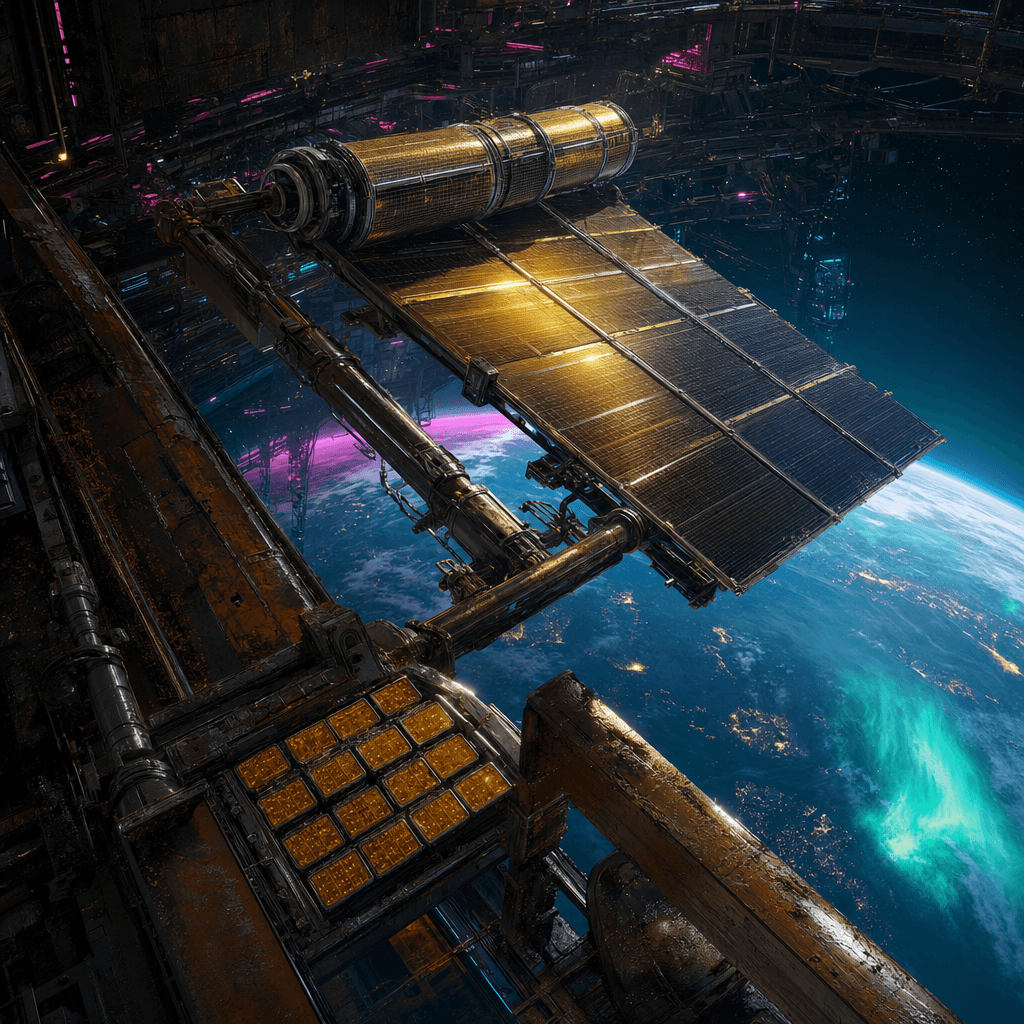
Fraunhofer Institut für Solare Energiesysteme (Fraunhofer ISE) and startup Source Energy have announced a joint development program to qualify silicon photovoltaic (PV) modules for satellite power applications — directly challenging the group III-V semiconductor cells that have held a near-monopoly on spacecraft solar arrays for decades. The case for silicon in space is fundamentally economic: Fraunhofer ISE and Source Energy's silicon satellite PV program (2026-08-05) is explicitly positioned as a more economical alternative to III-V cells currently used in space applications.
Why are III-V solar cells still used in space, and what do they cost?
III-V semiconductor solar cells — multi-junction devices built from materials such as gallium arsenide (GaAs), indium gallium phosphide (InGaP), and germanium — dominate satellite power because they convert sunlight at efficiencies of roughly 30–34% under the AM0 spectrum of low Earth orbit (LEO), while surviving the proton and electron radiation environment that degrades silicon far more quickly. The technology works, but it is expensive to manufacture: wafer-level epitaxial growth of III-V junctions runs orders of magnitude above the cost per watt of terrestrial silicon production lines. For a commercial constellation operator buying thousands of panels per year, that cost delta is no longer academically interesting — it is a programme-budget constraint.
Silicon PV, by contrast, is manufactured at gigawatt scale on Earth, with mature supply chains that have driven utility-scale module prices below $0.15 USD per watt in recent years. The engineering question is whether silicon cells can be ruggedised — through radiation shielding, cell architecture, or encapsulation design — sufficiently to deliver a competitive lifetime output in orbit at a system-level cost that beats III-V. Fraunhofer ISE, which holds the world record for several terrestrial silicon cell architectures, is now applying that manufacturing knowledge to the space domain alongside Source Energy (2026-08-05).
What does this demo prove — and what does it not yet prove?
At this stage, the program is a development and qualification effort, not a flight demonstration. That is an important distinction. To be bankable for a satellite prime contractor, silicon space PV modules will need to pass a defined qualification test sequence — European Cooperation for Space Standardization (ECSS) or equivalent — covering thermal cycling, vacuum UV exposure, proton irradiation, and end-of-life power degradation. None of that has been reported as complete. What the announcement does confirm is that two credible engineering institutions have committed resources to the problem and believe the cost argument is strong enough to justify the qualification investment.
The specific power figure — watts per kilogram (W/kg) — is the number that will ultimately determine whether silicon modules can compete in LEO constellations, where launch cost per kilogram remains a key system driver. SpaceX Falcon 9 rideshare pricing has brought LEO launch costs to roughly $5,500–6,000 USD per kilogram in 2025, and next-generation vehicles aim lower. At those rates, a silicon module that is heavier than a III-V equivalent but cheaper per watt may still win on total mission cost, depending on mission life and replacement cadence. The partnership has not yet published a specific-power target or a price-per-watt figure for its module design, which means the economic thesis remains a projection rather than a measurement.
What this means for your roadmap
For satellite bus manufacturers and constellation operators, this program is worth tracking through its qualification milestones rather than acting on today. The signal to watch is: does Source Energy progress to a ECSS-qualified module with a published radiation-tolerance dataset within the next 24 months? If so, the procurement conversation for post-2028 constellations becomes real.
For the broader power-in-space segment, the Fraunhofer ISE and Source Energy effort is one of several data points suggesting that the cost pressure from terrestrial solar manufacturing is finally reaching orbital applications. Constellation operators running hundreds or thousands of satellites on five-to-seven-year replacement cycles have a structurally different cost sensitivity than a geostationary (GEO) telecommunications satellite operator replacing a single $300M USD asset every 15 years. Silicon makes more economic sense for the former than the latter, and the market gravity is clearly pulling development in that direction.
The three questions to put to Fraunhofer ISE and Source Energy at the next industry conference: What is the target W/kg at beginning-of-life? What radiation dose — in krad(Si) — does the qualification envelope cover? And what is the projected module price per watt at volume production? Until those numbers are public, this remains a promising development program on the lab-to-orbit curve — and not yet a procurement decision.
Created with AI assistance. Editorial oversight: Juergen Ritzek. See our AI disclosure.