Briefing · September 5, 2026
SES O3b mPOWER Constellation Nears Completion as Europe's Launch Capital Race Heats Up
The final three O3b mPOWER satellites arrive at Cape Canaveral while European smallsat launchers raise hundreds of millions in fresh capital.
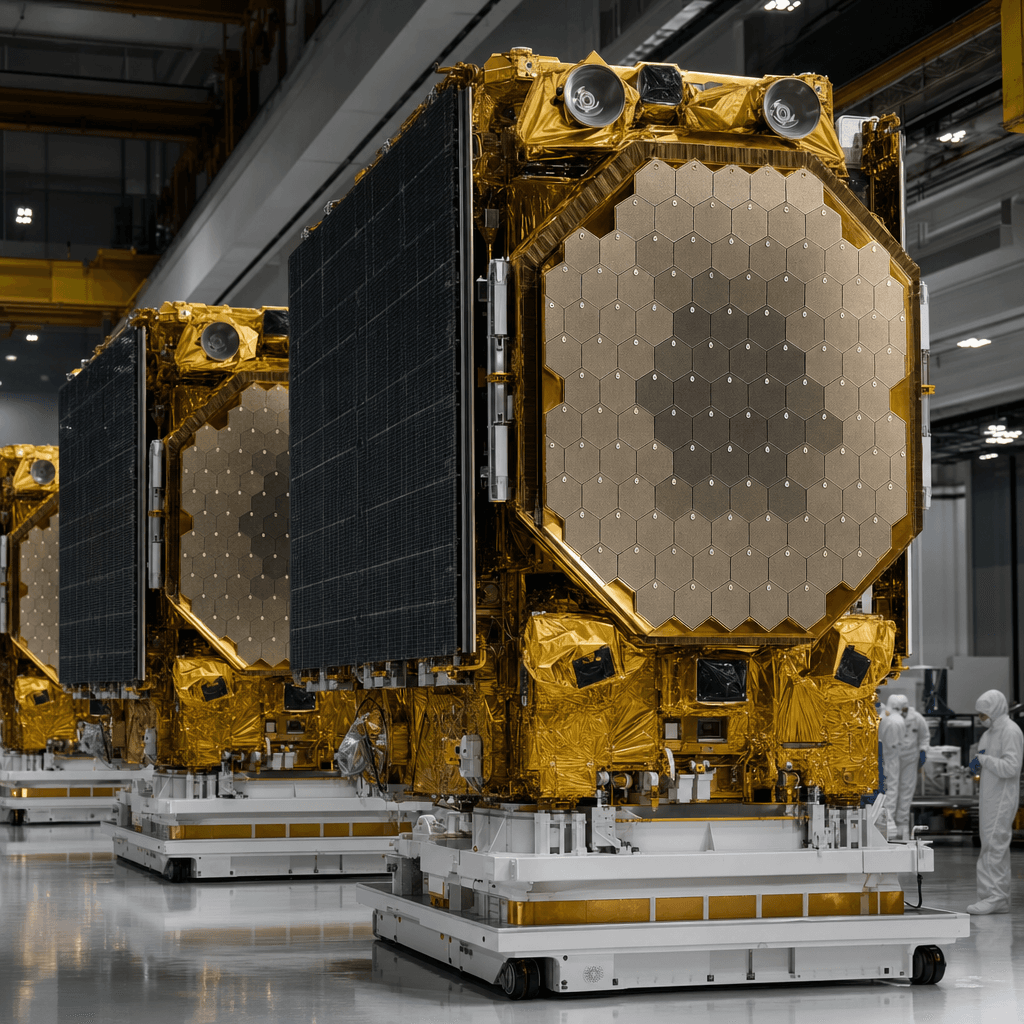
The space power and connectivity markets moved on three distinct fronts this week: a major medium-Earth-orbit (MEO) broadband constellation approached completion, and two European launch startups locked in substantial fresh capital — each development carrying direct implications for how power-hungry spacecraft reach orbit and how orbital infrastructure gets resourced.
What does the SES O3b mPOWER completion mean for orbital power demand?
On 3 September 2026, satellite operator SES confirmed that the final three satellites in its O3b mPOWER (medium-power, high-throughput) MEO broadband constellation had arrived at Cape Canaveral, Florida, ahead of a scheduled Falcon 9 launch by SpaceX. SatNews (2026-09-03) The O3b mPOWER constellation — built by Boeing and operated by SES — is the single most relevant current proof point that high-power, software-defined MEO satellites are commercially viable at scale. Each mPOWER spacecraft carries a fully digital, flexible payload designed to redirect power across thousands of spot beams in real time, making the constellation a working laboratory for the kind of agile power management that future orbital grids and space-based solar power (SBSP) relay architectures will depend on.
The evergreen concept: MEO broadband satellites like O3b mPOWER operate at roughly 8,000 km altitude — far below geostationary orbit (GEO) at 35,786 km — where round-trip signal latency drops to approximately 150 milliseconds, enabling real-time applications. The "mPOWER" designation refers to the payload's ability to electronically steer hundreds of high-power beams without physically moving the antenna, allocating watts and bandwidth on demand. This flexible power-routing architecture is precisely the capability that SBSP researchers argue will be needed to manage directed wireless power transmission from orbit to ground.
The completion of the O3b mPOWER fleet matters to space power stakeholders for a concrete reason: it validates that large, power-intensive digital payloads can be manufactured, launched, and commercially operated in non-GEO orbits. That is a Technology Readiness Level (TRL) milestone for orbital power infrastructure that lab-bench SBSP demonstrations cannot replicate.
Are European smallsat launchers building the on-ramp that space power missions need?
Two separate funding announcements this week signal that European sovereign launch capacity — the critical enabler for any European SBSP or lunar surface power mission — is consolidating capital at pace.
German launch services provider HyImpulse announced on 2 September 2026 that it had extended its Series A funding round by more than €50 million, bringing its total funding to date to €125 million. European Spaceflight (2026-09-02) HyImpulse is preparing for the second flight of its suborbital SR75 rocket and the inaugural launch of its larger SL1 orbital vehicle. Separately, Spanish launch services provider PLD Space secured an additional €108 million, extending its Series C round to a total of €288 million. European Spaceflight PLD Space is targeting the inaugural flight of its Miura 5 orbital rocket later in 2026.
Together, these two companies have now raised more than €413 million combined — a figure that would have seemed implausible for European smallsat launch three years ago. Neither vehicle is yet orbital-proven, which is the critical distinction. A Series C extension is not a launch manifest. €288 million in the bank does not equal a demonstrated fairing load delivered to a 500 km sun-synchronous orbit (SSO). For anyone planning a lunar surface power demonstrator or a low-Earth-orbit (LEO) power-beaming technology satellite, the honest read is: European sovereign launch is 12–24 months from being a credible alternative to Falcon 9 for small payloads, not zero months.
What this means for your next decision
If you are allocating R&D budget toward a LEO power-beaming demonstrator or a lunar power relay, this week's news tightens two variables in your planning model. First, the O3b mPOWER completion confirms that high-power flexible-payload MEO operations are no longer experimental — they are operational, and their procurement, insurance, and ground-segment data are becoming available for benchmarking. Second, European launch is accumulating capital faster than flight heritage, which means procurement teams should be tracking Miura 5 and SL1 first-flight outcomes in Q4 2026 and H1 2027 as the real signal — not the funding headlines. Capital follows ambition; launch manifests follow demonstrated performance. Watch the range schedules, not the press releases.
Created with AI assistance. Editorial oversight: Juergen Ritzek. See our AI disclosure.