Briefing · November 18, 2026
Reflect Orbital's $73.5M Raise and Starship's Full Reusability Put Space Solar Economics in Motion
Reflect Orbital closes a $73.5M round as Starship IFT-15 proves full reusability — two signals that reshape the launch-cost barrier for space solar.
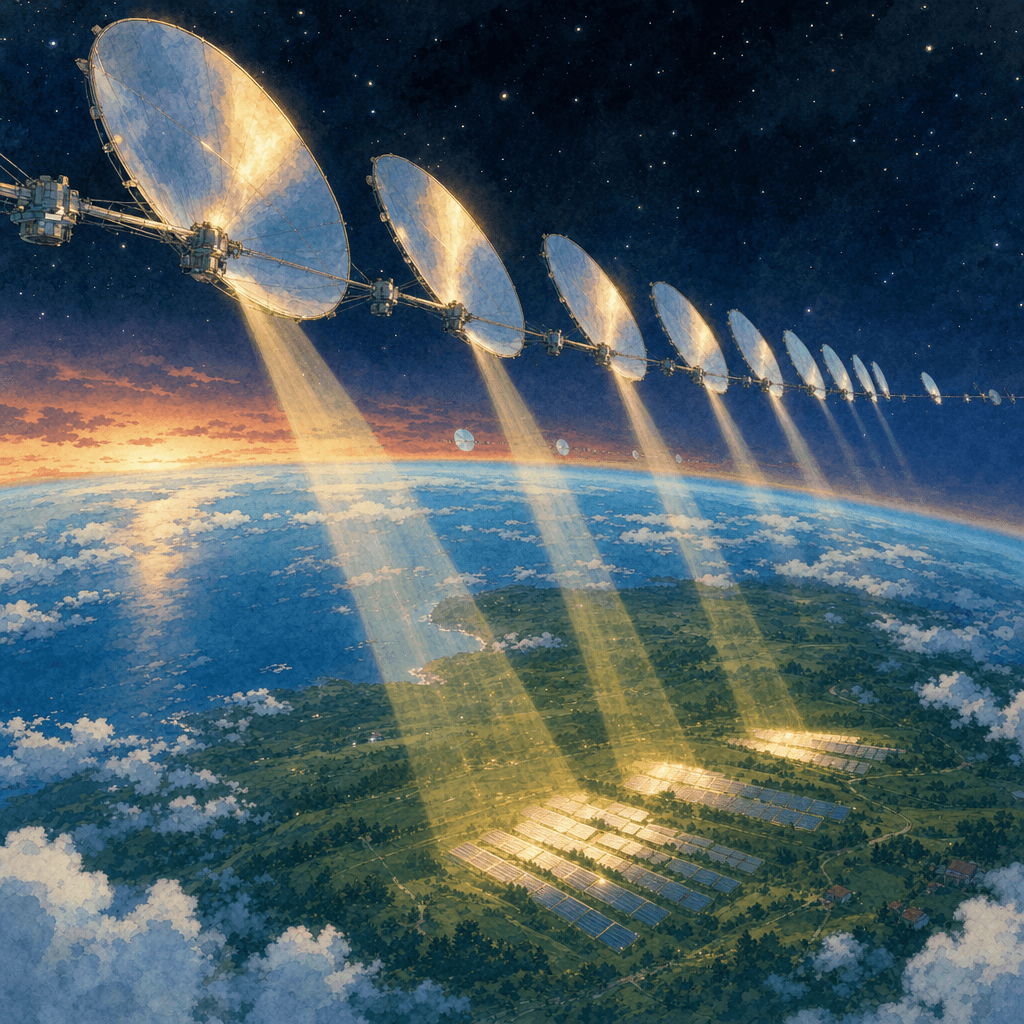
Two events this month, taken together, shifted the near-term calculus for space-based solar power (SBSP) more than any single lab demonstration has in years. First: Reflect Orbital closed a US$73.5 million funding round (2026-11-13) to advance its constellation of orbital mirrors that extend ground-level solar generation hours after dark. Second: SpaceX completed Integrated Flight Test 15 (IFT-15) on November 2026, catching the Starship upper stage at the launch tower after 14 orbital passes — the first fully reusable orbital-class vehicle in history to recover both stages intact.
Neither event alone builds a power plant. Together, they describe a corridor through which the economics of delivering hardware to orbit may finally become defensible.
What did Reflect Orbital actually prove — and what does it still need to prove?
Reflect Orbital's approach differs from classic SBSP: rather than converting sunlight to microwaves and transmitting them to a rectenna, the company deploys large reflecting mirrors in low Earth orbit (LEO) to redirect raw sunlight onto existing terrestrial photovoltaic (PV) farms during post-sunset hours. The concept is straightforward — extend the daily generation window of ground assets already paid for, without the wireless power transmission (WPT) link that remains SBSP's most technically contested component.
The US$73.5 million round (2026-11-13) is a Series-level commitment, not a government study contract, which means private capital has now priced the orbital reflector concept as commercially plausible within a fundable timeframe. What it does not prove: on-orbit mirror deployment at scale, pointing precision adequate for commercial PV illumination, or end-to-end energy yield that undercuts grid storage alternatives. Those remain engineering milestones ahead of the company, not behind it.
For readers mapping this against the SBSP readiness ladder: Reflect Orbital sits at approximately Technology Readiness Level (TRL) 4–5 — component validation in a relevant environment is imminent, but system demonstration in orbit is not yet complete. The funding gets them to that next rung.
Why does Starship's full recovery matter to space solar specifically?
Space solar's fundamental economic constraint has never been panel efficiency or microwave conversion — it has been launch cost per kilogram to geostationary Earth orbit (GEO). A conventional SBSP architecture requires tens of thousands of tonnes of hardware in GEO, where launch costs on existing vehicles are measured in thousands of USD per kilogram. That arithmetic has killed every serious SBSP business plan since the 1979 NASA reference design.
Starship changes the denominator. SpaceX's IFT-15 (November 2026) demonstrated full booster and upper-stage recovery from orbit for the first time, completing the reusability architecture the company has pursued since Falcon 9's first-stage landings. Operationally, two Starship test flights in a six-week window each deployed 26 Starlink V3 satellites, and that payload cadence already exceeds nine weeks of Falcon 9 capacity on a mass basis. Starship's target payload to LEO exceeds 100 tonnes (fully reusable configuration), and SpaceX's internal cost targets — if achieved — point toward sub-$100/kg to LEO at high flight rates.
Sub-$100/kg to LEO does not automatically translate to affordable GEO SBSP; orbital transfer stages, on-orbit assembly, and specific power (W/kg) of the array architecture all matter. But it removes the ceiling that has made the entire conversation academic for two decades.
The plain-language mechanism both stories share
Space-based solar power, in its broadest definition, works by intercepting solar radiation above Earth's atmosphere — where there is no night, no cloud cover, and no atmospheric absorption — and delivering that energy to Earth's surface, either as microwaves, laser, or reflected visible light. The critical insight is that a solar collector in GEO receives roughly eight times more annual energy than the same collector on the ground. The critical problem has always been getting enough mass into that orbit cheaply enough that the delivered energy cost is competitive with ground alternatives, currently around $30–80/MWh for utility-scale solar-plus-storage in favorable markets.
What this means for your roadmap this week
If you are evaluating SBSP or orbital energy infrastructure investments, two data points now require updating: your assumed $/kg to orbit (trending down faster than most five-year models assumed), and your competitive baseline (Heliene and Caelux are targeting 27%-efficiency perovskite-silicon tandem modules for 2027 shipment, which raises the terrestrial benchmark that any space system must beat). Reflect Orbital's raise signals that at least one investor syndicate has done that arithmetic and found a window. The question for everyone else is whether the orbital demonstration, when it comes, closes the remaining gap — or reveals a new one.
Created with AI assistance. Editorial oversight: Juergen Ritzek. See our AI disclosure.