Briefing · November 7, 2026
Orbital Matter's 2028 In-Space 3D-Printed Solar Array Is a Specific Bet Worth Watching
Orbital Matter and EnduroSat plan a 2028 mission to 3D-print a 5 kW solar array in orbit — here's what that proves and what it doesn't.
What did Orbital Matter and EnduroSat actually announce?
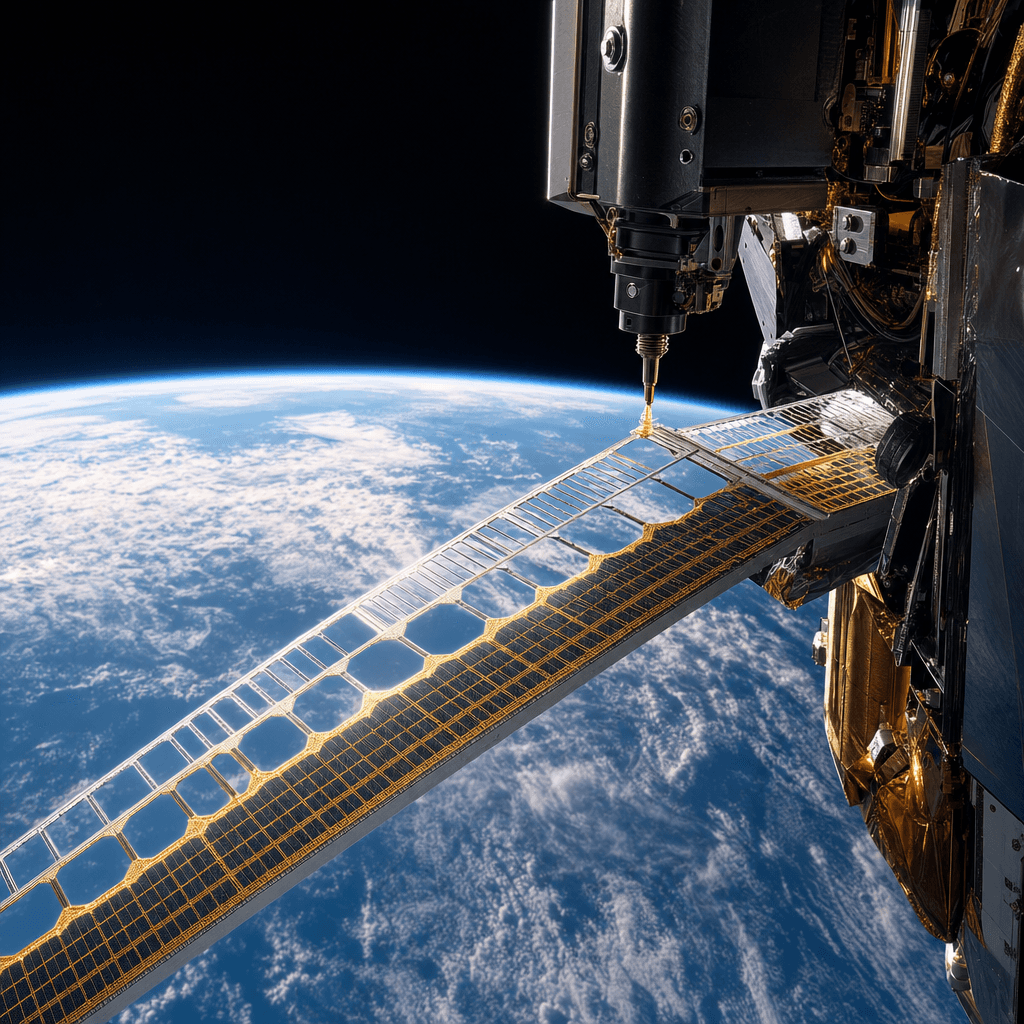
In November 2026, Orbital Matter and EnduroSat jointly announced a mission scheduled for 2028 to deploy a 5 kW solar array manufactured in orbit using 3D printing, making it one of the first concrete, dated demonstrations of in-space solar structure fabrication by a commercial partnership. Orbital Matter / EnduroSat (2026-11)
That single sentence carries real weight for the power-in-space community: Orbital Matter and EnduroSat intend to use additive manufacturing hardware aboard a satellite platform to print and deploy a solar array generating 5 kilowatts as of the 2028 mission date, entirely in the orbital environment. It is not a ground demonstration dressed up in a press release. It is a committed flight manifest with a named satellite integrator and a named output power target. That distinction matters enormously on the demo→deployment curve.
Why does in-space manufacturing matter for solar power architectures?
In-space manufacturing (ISM) refers to the fabrication of structures, components, or materials in the orbital environment rather than on the ground — the core argument being that you remove the mass and volume constraints imposed by the launch fairing and by the need to survive launch loads. For solar power applications specifically, ISM is the enabling technology that could allow very large, low-areal-density photovoltaic arrays to be constructed at scale without being folded, packed, and unfolded. Every space-based solar power (SBSP) architecture proposed to date — from the European Space Agency's (ESA) SOLARIS concept to the studies by the UK Space Energy Initiative — eventually runs into the same wall: you cannot cheaply launch a gigawatt-scale array pre-built. ISM is the theoretical answer; a 5 kW orbital demo in 2028 is the first commercial attempt to put numbers on what that actually costs and how well the hardware performs.
The 5 kW figure itself sits at Technology Readiness Level (TRL) 4–5 territory in terms of the broader SBSP roadmap: it proves the print-and-deploy mechanism works in vacuum and thermal cycling, but it does not yet prove scalability to the tens or hundreds of megawatts needed for a grid-relevant power satellite. Investors and program officers should read the 2028 mission as a materials and process qualification flight, not a revenue-generating power platform.
What does this mean alongside the broader in-space power landscape?
Context helps calibrate the ambition. Also in November 2026, CesiumAstro closed a 730M USD financing round and announced plans to build and deploy a 737-satellite constellation called Synchronicity, reaching a valuation above 4.5 billion USD. CesiumAstro (2026-11) CesiumAstro's focus is communications payload technology, not solar power generation, but the scale of that capital raise illustrates the gap between what the market is currently paying for in space (connectivity) versus what remains early-stage (in-space power manufacturing). Orbital Matter's 2028 mission will be operating in a capital environment where large constellation plays attract nine-figure rounds and in-space manufacturing is still seeking its first orbital proof point.
That gap is precisely why the 2028 demo timeline is credible rather than aggressive: EnduroSat has an established record as a small satellite integrator, and a two-year runway to a first flight is consistent with the complexity of flying a novel fabrication payload on a commercial platform. The risk is not schedule — it is performance. Printing a 5 kW array in orbit requires the thermal management, mechanical deployment, and photovoltaic integration to all function in an environment that has ended more than one "simple" demo.
The number that the 2028 mission must produce
The metric that will determine whether this mission advances the SBSP roadmap or stays a curiosity is specific power in watts per kilogram (W/kg) for the printed array, measured on-orbit in 2028. Ground-manufactured, deployable solar arrays for spacecraft currently achieve roughly 150–200 W/kg at the panel level in state-of-the-art designs. If Orbital Matter's 3D-printed structure delivers specific power competitive with or superior to that benchmark, the case for ISM as a path to low-launch-mass SBSP grows materially stronger. If the printed structure is heavier per watt than a conventionally launched array, the economic argument collapses regardless of how elegant the fabrication process is.
For executives and investors tracking the in-space power manufacturing space: flag the 2028 Orbital Matter–EnduroSat mission on your roadmap review calendar now, and set a specific trigger — W/kg reported from orbit — as the number that determines whether a follow-on bet is warranted.
Created with AI assistance. Editorial oversight: Juergen Ritzek. See our AI disclosure.