Briefing · August 18, 2026
Orbital Data Centres Want Space Solar Power — Here's What the Physics Actually Allows
AI data centres consuming the equivalent of 100,000 homes are eyeing orbital solar and radiative cooling — but the engineering constraints are unforgiving.
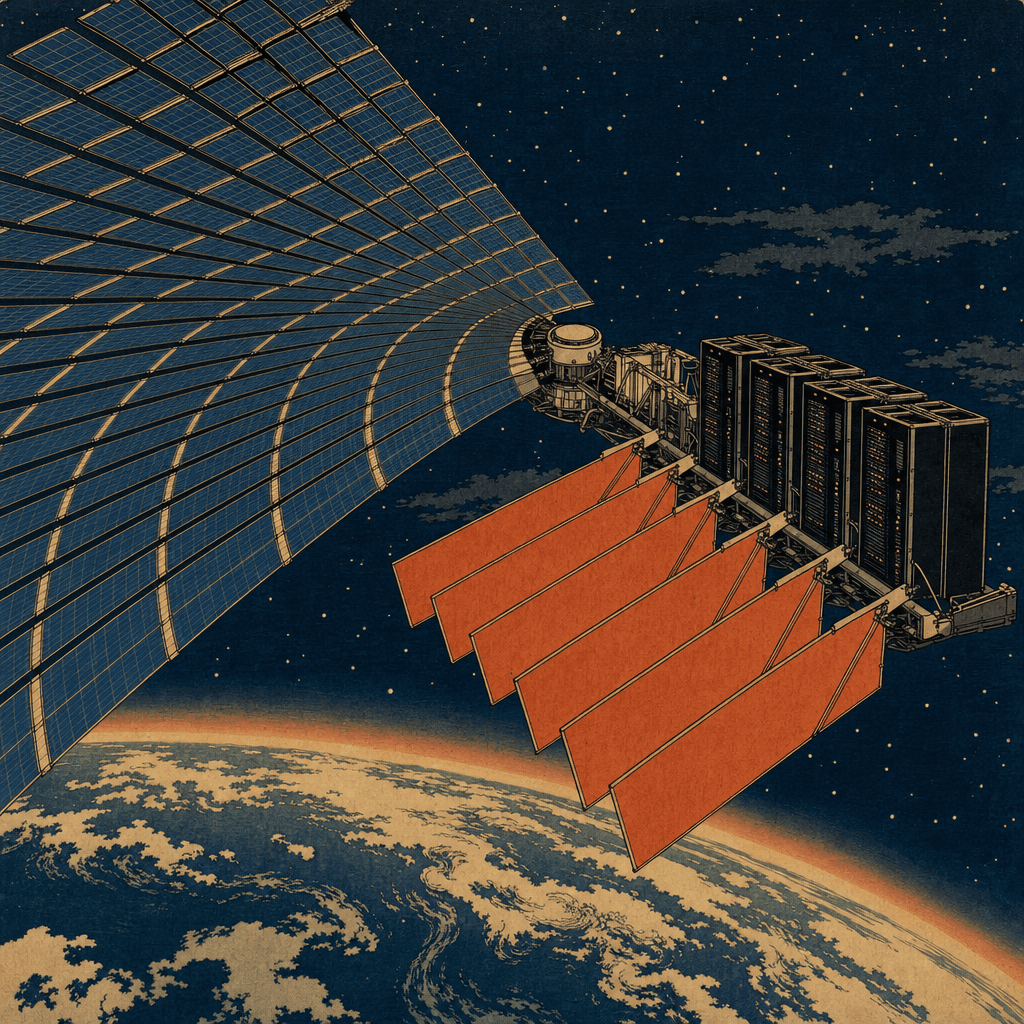
A single AI-focused data centre can consume as much electricity as 100,000 homes, and the industry is now asking whether moving those racks to orbit — where sunlight is nearly continuous and waste heat can be radiated into the cold of space — makes engineering sense, according to Space Daily (2026-08-10). That framing deserves a hard look before anyone books a launch manifest slot.
What does "orbital solar power for a data centre" actually mean?
Space-based solar power (SBSP) is the concept of collecting solar energy in orbit — where the sun shines roughly 8–10 times more energy per square metre per day than a ground-based panel after accounting for atmosphere, night and weather — converting it to electricity, and either using it locally in space or transmitting it to Earth. For an orbital data centre, the pitch skips the transmission step: generate the power where you need it, cool the servers with giant radiators, and sell compute cycles over laser or radio links. The technology building block is photovoltaic conversion in orbit; the economic question is whether the cost per watt-delivered can beat terrestrial solar-plus-storage, which is now well below $100/MWh in most markets.
Has the surface-area constraint replaced the mass constraint?
This is the structural shift worth tracking in 2026. As SpaceNews (2026-03) argues, falling launch prices — driven by rideshare programmes like SpaceX Transporter — have relocated the bottleneck from kilograms to deployable aperture. You can now afford to put mass in orbit; what you cannot easily do is unfurl the square kilometres of solar array a gigawatt-class system requires inside a fairing and on a realistic deployment schedule. For a data-centre-scale application, the numbers are more tractable: a 1 MW orbital facility needs roughly 3,000–5,000 m² of photovoltaic area at current panel efficiencies (~20–28%), which is achievable with large-format deployable structures already in development. But that is three orders of magnitude below what a utility-scale SBSP plant would need — so the orbital data centre is a power-in-space application, not a proof-of-concept for power-to-Earth.
What does it not yet prove — and what is the live demo record?
No orbital data centre has operated at scale as of mid-2026. The closest adjacent demonstrations involve optical power and data links rather than megawatt-class solar collection. Astrolight and ATMOS Space Cargo signed a memorandum of understanding in August 2026 to demonstrate the first in-flight laser link between a re-entry vehicle and a satellite, a mission that would validate spacecraft-to-spacecraft optical connectivity — a prerequisite for any orbital compute node that needs to offload data at useful rates, according to SatNews (2026-08-10) and SpaceNews (2026-08). That is a technology readiness level (TRL) 4–5 milestone for the link, not for the power plant.
On the machine-learning side, a pre-print published in August 2026 proposes a hierarchical prediction model for energy scheduling in non-terrestrial network wireless power transfer (NTN-WPT) systems — transferring power from low Earth orbit (LEO) satellites to ground receivers — demonstrating joint optimisation of energy efficiency, task completion rate and task waiting time, but only in simulation, not in hardware, according to arXiv (2026-08). Simulation is not a watt delivered.
The radiator problem nobody is talking about
Cooling is the silent constraint. A terrestrial hyperscale data centre running at 100 MW rejects roughly 100–150 MW of waste heat through water cooling towers. In orbit, every joule must leave as thermal radiation, which scales with surface area and the fourth power of temperature. A 100 MW heat load at 40°C operating temperature requires approximately 5,000–10,000 m² of radiator panel — comparable to the solar array itself. Doubling the deployed area requirement doubles the launch volume, the deployment risk and the on-orbit assembly complexity. None of the current orbital data centre concepts have published detailed radiator mass budgets in peer-reviewed form.
What this means for your next decision
The orbital data centre concept is not vapourware — the thermodynamics are real and the solar resource advantage is quantifiable. But as of August 2026, no orbital facility has demonstrated sustained megawatt-class power generation with co-located compute, and the structural engineering challenge of deploying paired solar-plus-radiator arrays at scale remains unsolved in hardware. If you are evaluating a partnership or investment in this space, the questions to press on are specific-power targets in W/kg for the combined solar-and-radiator system, the TRL of the deployment mechanism, and the all-in cost per delivered compute-hour compared to terrestrial alternatives — because the benchmark is not standing still.
Created with AI assistance. Editorial oversight: Juergen Ritzek. See our AI disclosure.