Briefing · September 26, 2026
Nuclear Batteries in Orbit: What Tritium Betavoltaics Mean for Lunar Surface Power
Tritium betavoltaic cells are being tested in space for the first time — here's what that demo proves, and what it still doesn't.
What just happened in lunar surface power?
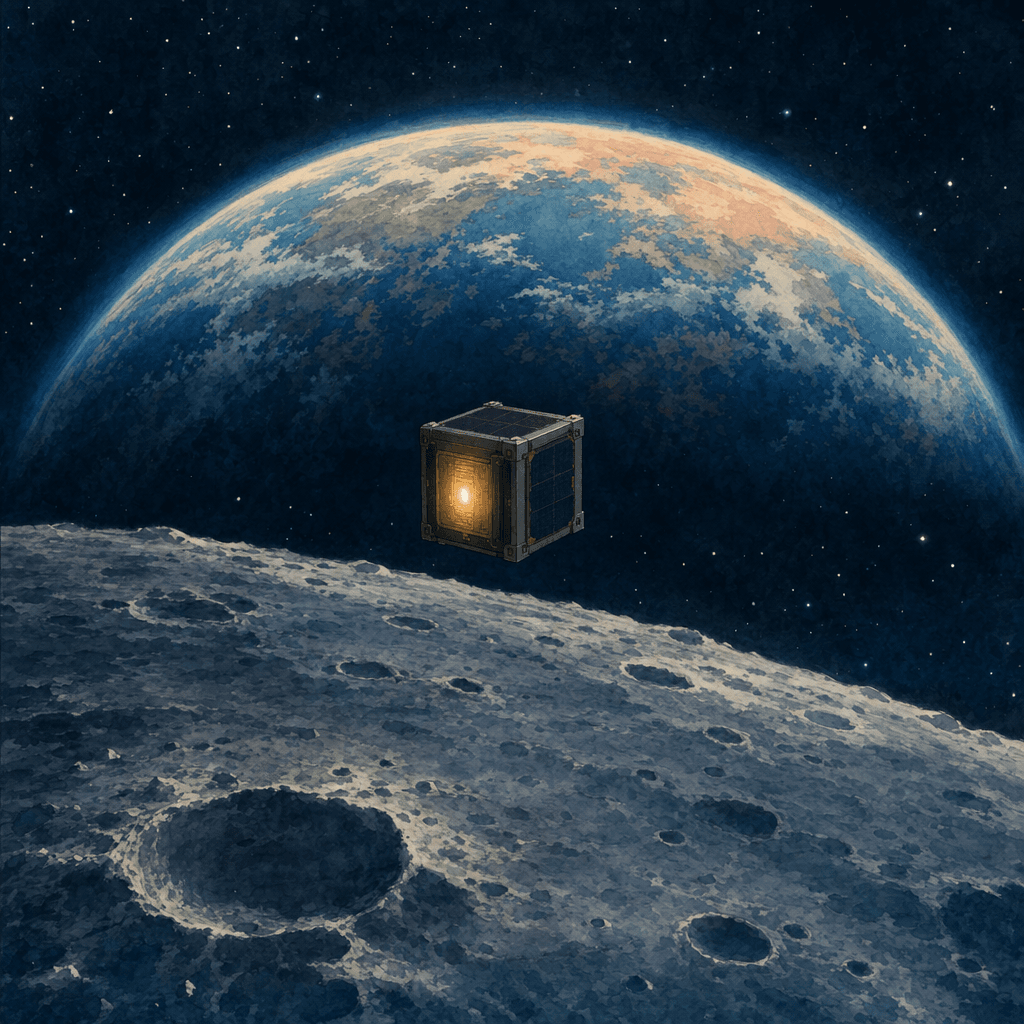
Tritium betavoltaic cells — nuclear "batteries" that convert the low-energy electrons emitted by tritium decay directly into electricity — are being tested in space for the first time, according to IEEE Spectrum (2026). That is the milestone: not a whitepaper, not a ground thermal-vacuum test, but an on-orbit demonstration aboard a CubeSat. A single sentence worth extracting from this moment: tritium betavoltaic cells, now flying in orbit for the first time, produce electricity continuously from radioactive decay and do not require sunlight, making them a candidate baseline power source for the 14-day lunar night.
The relevance to lunar surface power programs, including those planned under Artemis, is direct. The lunar night lasts approximately 354 hours — nearly 15 Earth days — during which surface temperatures can drop below –130 °C. Photovoltaic arrays go dark; batteries capable of bridging that gap at useful power levels add prohibitive mass. Betavoltaics sidestep both problems, at least in principle.
How do betavoltaic cells actually work?
Betavoltaics are the nuclear analogue of a solar cell. Where a photovoltaic cell converts photons into electron-hole pairs in a semiconductor junction, a betavoltaic cell converts beta particles — high-speed electrons emitted during the radioactive decay of an isotope such as tritium (hydrogen-3) — into current across a similar junction. Tritium has a half-life of approximately 12.3 years, which means a tritium betavoltaic cell loses roughly half its output power over that interval, but delivers power continuously with no fuel feed, no moving parts, and no dependence on the solar cycle. The technology has existed in the laboratory for decades; what is new, per IEEE Spectrum (2026), is the first space qualification attempt.
What does the demo prove — and what does it not yet prove?
This is where skepticism earns its keep. An on-orbit CubeSat demonstration establishes survivability in the space radiation environment and validates the packaging at small scale. It does not yet prove:
- Scalability to useful surface power levels. Betavoltaic cells are currently low-power devices. The power density of tritium betavoltaics remains far below that of radioisotope thermoelectric generators (RTGs) or fission surface power systems. NASA's Fission Surface Power project targets 10 kW electrical for initial lunar surface operations — a threshold betavoltaics are not positioned to meet in the near term.
- End-of-life performance under lunar regolith and thermal cycling. CubeSat orbit is not the lunar surface. Dust adhesion, micrometeorite flux, and repeated 300 °C thermal swings between lunar day and night are a different qualification regime entirely.
- Cost-competitiveness against alternatives. RTGs using plutonium-238 are flight-proven but constrained by Pu-238 production capacity. Fission systems are higher-power but require regulatory pathways. Betavoltaics using tritium face their own supply and licensing questions that the current demo does not address.
Place this on the demo-to-deployment curve: the tritium betavoltaic CubeSat flight is a technology readiness level (TRL) 6 event — system prototype demonstrated in a relevant environment. TRL 9, meaning an actual qualified system operating on the lunar surface, requires years of additional work and a mission architecture willing to carry it.
What should Artemis surface power planners take from this?
NASA Administrator nominee Jared Isaacman has promised an "Artemis acceleration" update in early October 2026, per Payload Space (2026-09-24). That update is expected to address the many "ingredients" — his word — needed before a crewed lunar landing, and surface power is near the top of that list. The betavoltaic demo will not change the October briefing, but it should inform the 2027–2030 surface power technology investment portfolio.
The practical read for program officers and investors: tritium betavoltaics are worth a funded watch, not a funded program. The right next step is a lunar-surface analog thermal-cycling test and an honest published power-density number — watts per kilogram at end-of-mission — benchmarked against RTG and small fission alternatives. Until that comparison exists in the open literature, betavoltaics remain a promising hedge in the lunar night power toolkit, not a solution ready for a procurement decision.
The CubeSat now in orbit is asking the right first question. The answer will take at least one more mission to read clearly.
Created with AI assistance. Editorial oversight: Juergen Ritzek. See our AI disclosure.