Briefing · October 17, 2026
NASA's Moon Base Power Problem: What the 2028 Deadline Means for Lunar Surface Energy
NASA's push to land astronauts on the Moon by 2028 is forcing hard engineering choices on surface power — and the battery data is sobering.
What is actually driving NASA's lunar surface power timeline?
NASA's National Aeronautics and Space Administration (NASA) has publicly committed to returning American astronauts to the Moon's surface by 2028, a deadline that is now forcing concrete engineering decisions rather than architecture studies. NASA's October 2026 Artemis briefing confirmed the acceleration of Artemis III and subsequent missions, with details tied directly to surface readiness — not just launch vehicle status. Shatel Bhakta, NASA's principal systems engineer for Moon Base, has been publicly discussing the incremental steps required between now and 2028, framing the challenge as a systems integration problem with power at its centre, according to SpaceNews (2026-10).
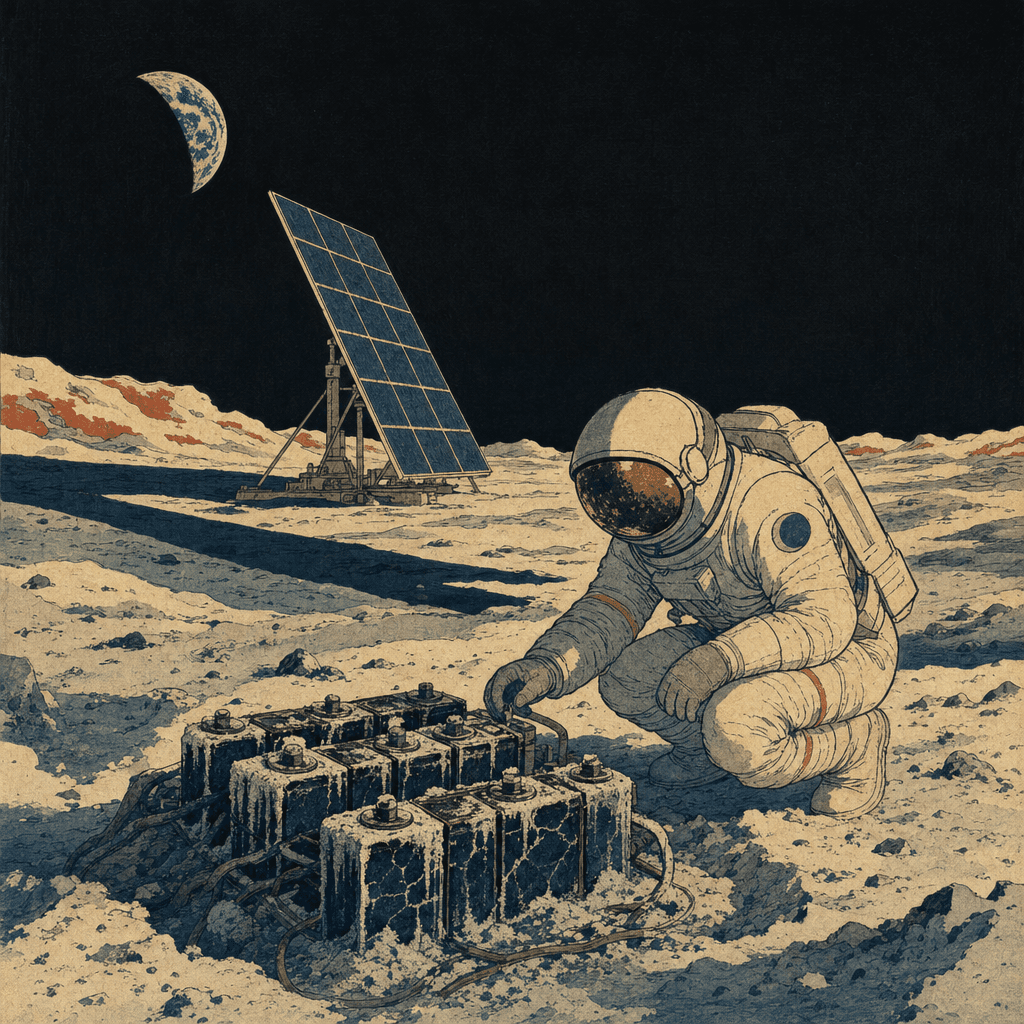
The core finding that planners cannot paper over: nighttime temperatures at the lunar South Pole plunge to approximately minus 280 degrees Fahrenheit (minus 173 degrees Celsius), a thermal environment that disables conventional lithium-ion chemistry entirely — meaning any surface power architecture that relies on battery storage for the roughly 14-Earth-day lunar night must use cold-tolerant chemistry that does not yet exist at flight-ready maturity.
Why do standard batteries fail on the Moon, and what is NASA doing about it?
Conventional electrochemical batteries depend on ion mobility between electrodes through a liquid electrolyte; below roughly minus 40 degrees Celsius, that electrolyte becomes too viscous to sustain useful discharge rates, and capacity drops sharply. NASA Langley Research Center researchers are actively developing battery chemistries designed to remain functional at South Pole nighttime lows, targeting the specific thermal range that commercial cells cannot reach, as described in NASA's Langley battery development programme (date unspecified). This is a Technology Readiness Level (TRL) problem: a chemistry that works in a Langley lab is not the same as a flight-qualified cell, and a flight-qualified cell is not the same as a validated energy storage system integrated with solar arrays and thermal management hardware.
The distinction matters for anyone planning a lunar surface power procurement. The gap between a demonstrated cold-tolerant cell and a bankable, integrated energy storage unit could be measured in years and hundreds of millions of dollars of qualification testing.
How does the ISS solar experience inform what comes next on the Moon?
The International Space Station (ISS), orbiting at 250 miles above Earth, provides the most operationally relevant dataset on long-duration space solar power systems. Over the past five years, NASA has augmented the station's power supply with Roll-Out Solar Arrays (ROSAs), a modular, stowable photovoltaic architecture that increases total station power generation, according to NASA's ISS power-up programme overview. The ISS operates in low Earth orbit (LEO) where eclipse periods last roughly 35 minutes per 90-minute orbit — a very different duty cycle from the 14-day lunar night, but the ROSA form factor and deployment heritage are directly relevant to what compact, deployable arrays might look like on the lunar surface.
The lesson from ISS is not that solar works in space — that is settled — but that modular, field-deployable array architecture can be iterated and upgraded without replacing the entire power plant. That design philosophy needs to translate to the Moon, where resupply is not a quarterly Cargo Dragon flight.
What the 2028 timeline means for your roadmap
For surface power specifically, the 2028 crewed landing target creates a forcing function with at least three hard constraints. First, any energy storage technology entering the critical design review process today must already be past TRL 5 (component validation in relevant environment) to have a credible path to flight qualification. Second, the solar array architecture selected for Artemis surface missions will likely set the form-factor standard for commercial follow-on lunar outpost power systems for a decade. Third, the battery chemistry question is not solved: NASA Langley's cold-tolerant development work is active research, not a product ready for procurement.
If you are an investor or programme officer evaluating lunar surface power plays in late 2026, the signal is clear: the technology gap is in energy storage for the night period, not in solar generation. The team that delivers a flight-qualifiable, cold-tolerant battery system on a timeline consistent with 2028 human landing preparation holds genuine programme leverage — and NASA's own roadmap confirms the gap is real.
Created with AI assistance. Editorial oversight: Juergen Ritzek. See our AI disclosure.