Briefing · October 9, 2026
NASA's GIMLI Mission Will Probe Whether Lunar Pits Can Host Surface Power Infrastructure
NASA's GIMLI robot is heading to the Marius pit — and the power case for lunar lava tubes is more concrete than the shelter case.
What is NASA's GIMLI mission, and why does it matter for lunar surface power?
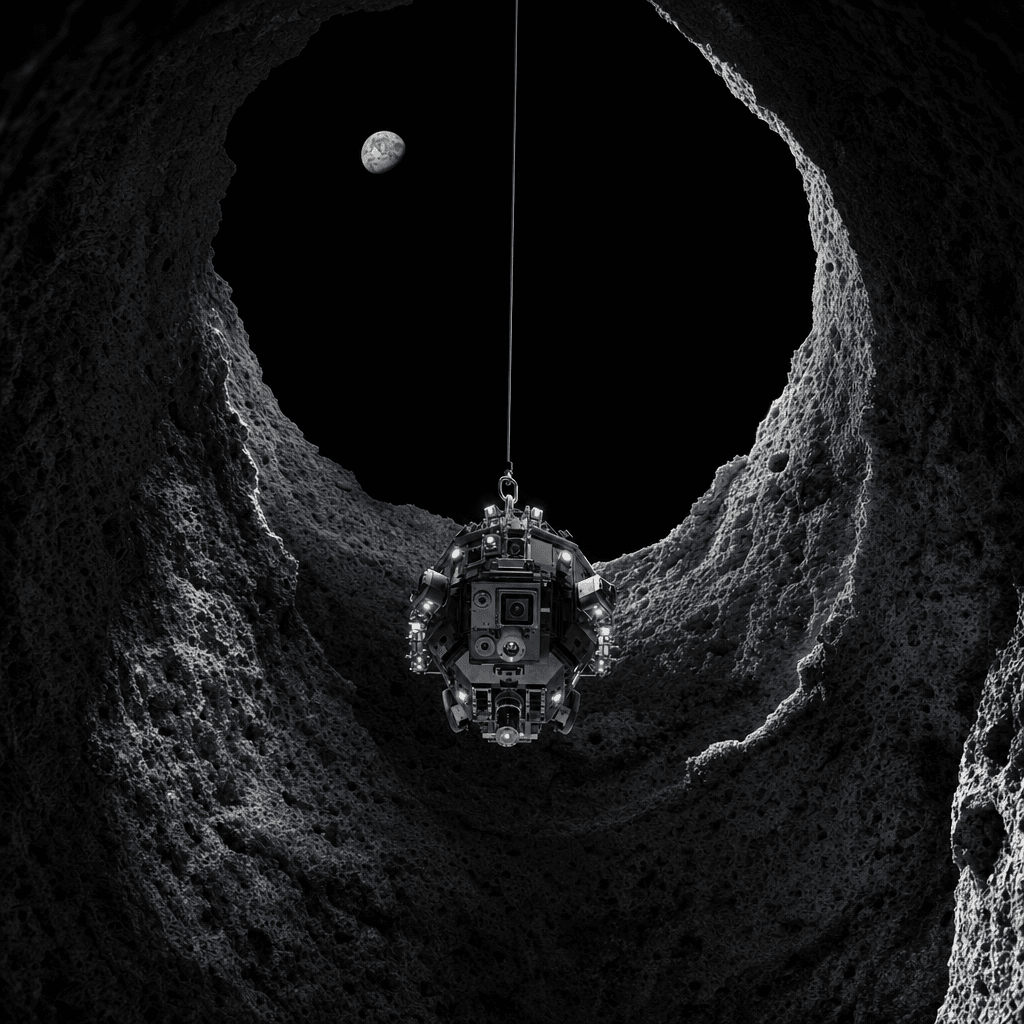
NASA has selected the Geophysical In-situ Measurement of Lunar Interior (GIMLI) mission to descend into the Marius Hills pit, a collapse feature on the lunar nearside that may open into an intact lava tube tens of metres wide and potentially several kilometres long. GIMLI's assignment is to characterise the pit's geometry, radiation environment, and thermal stability — the three variables that determine whether a lava tube is survivable infrastructure or merely a geological curiosity. Universe Today (2026-10-08) reports that the mission targets the Marius Hills pit specifically because orbital data from the Lunar Reconnaissance Orbiter (LRO) already suggests a void space below the 50-metre-diameter skylight opening.
The self-contained finding that drives this week's editorial: NASA's GIMLI mission, selected in late 2026, will be the first robot to descend into the Marius Hills lunar pit and measure the radiation dose rate, temperature swing, and structural dimensions that determine whether a lava tube can host a long-duration human or robotic base — including its power infrastructure.
How does a lunar pit change the surface power equation?
Surface power for the Moon, one of the three beats this publication tracks, is not just about generating watts — it is about surviving the 14-Earth-day lunar night and a radiation environment that delivers roughly 380 millisieverts per year on the open regolith, compared with approximately 6 millisieverts per year at sea level on Earth. A lava tube with even 5–10 metres of basalt overhead cuts the galactic cosmic ray dose by an order of magnitude and compresses the temperature swing from the surface's brutal −173 °C to +127 °C range to something a base load power system can manage without exotic thermal control mass.
That reframes the power architecture decision entirely. On the open surface, solar arrays must survive those temperature extremes, and any base requires either a nuclear fission surface power unit — NASA and the Department of Energy (DOE) are targeting a 10 kWe fission system demonstration on the lunar surface by the late 2020s under the Fission Surface Power (FSP) program — or a battery and regenerative fuel cell stack large enough to bridge the two-week night. Inside a thermally stable tube, the night-survival energy budget shrinks, solar array lifetime improves, and the specific power (W/kg) argument for bringing a nuclear reactor weakens somewhat.
None of that analysis is bankable until GIMLI delivers the numbers. What the mission does not prove is habitability, structural integrity over seismic timescales, or accessibility for cargo landers — those questions remain open and will require follow-on missions.
What does in-flight laser power beaming tell us about the same technology at lunar scale?
The power-in-space and power-on-worlds beats converged this week around a parallel data point. Researchers in China demonstrated a laser power transfer system capable of recharging a drone mid-flight using a directed laser beam. IEEE Spectrum (2026-10-08) reports that the team designed the drone's fuselage as a photovoltaic receiver to maximise collection area, and that the system could "significantly boost drone flight time" — though the published results stop short of specifying end-to-end wall-plug efficiency or watts delivered at the receiver, which limits its direct comparability to space power beaming proposals.
Laser power beaming — the transmission of energy as a focused beam of light, received by a photovoltaic array and converted back to electricity — is the same mechanism proposed for beaming power from a lunar orbital relay to a pit-based surface installation, or from a space-based solar power (SBSP) satellite to a terrestrial rectenna. The drone demo is a Technology Readiness Level (TRL) 4–5 result: it proves the concept in a controlled environment but not at the range, power level, or pointing precision required for a lunar relay or an SBSP application.
The decision your roadmap needs to make
If you are allocating R&D budget or partnership bandwidth in the lunar surface power space right now, GIMLI sets your critical-path dependency. Until its data is returned — geometry confirmed, radiation dose measured, thermal profile logged — any lava-tube power architecture is a slide deck, not an engineering baseline. Watch for NASA to publish the mission's instrument suite and launch window; that timeline will set the earliest date a tube-hosted power node can be costed with defensible numbers. In the meantime, the FSP program's open-surface architecture remains the only option with a firm hardware roadmap.
Created with AI assistance. Editorial oversight: Juergen Ritzek. See our AI disclosure.