Briefing · November 11, 2026
NASA's $1.3B CLPS 2.0 Awards Signal Serious Intent on Lunar Surface Power
NASA's eight-provider CLPS 2.0 structure creates the delivery calendar lunar surface power programs need — but hardware readiness is the binding constraint, not launch slots.
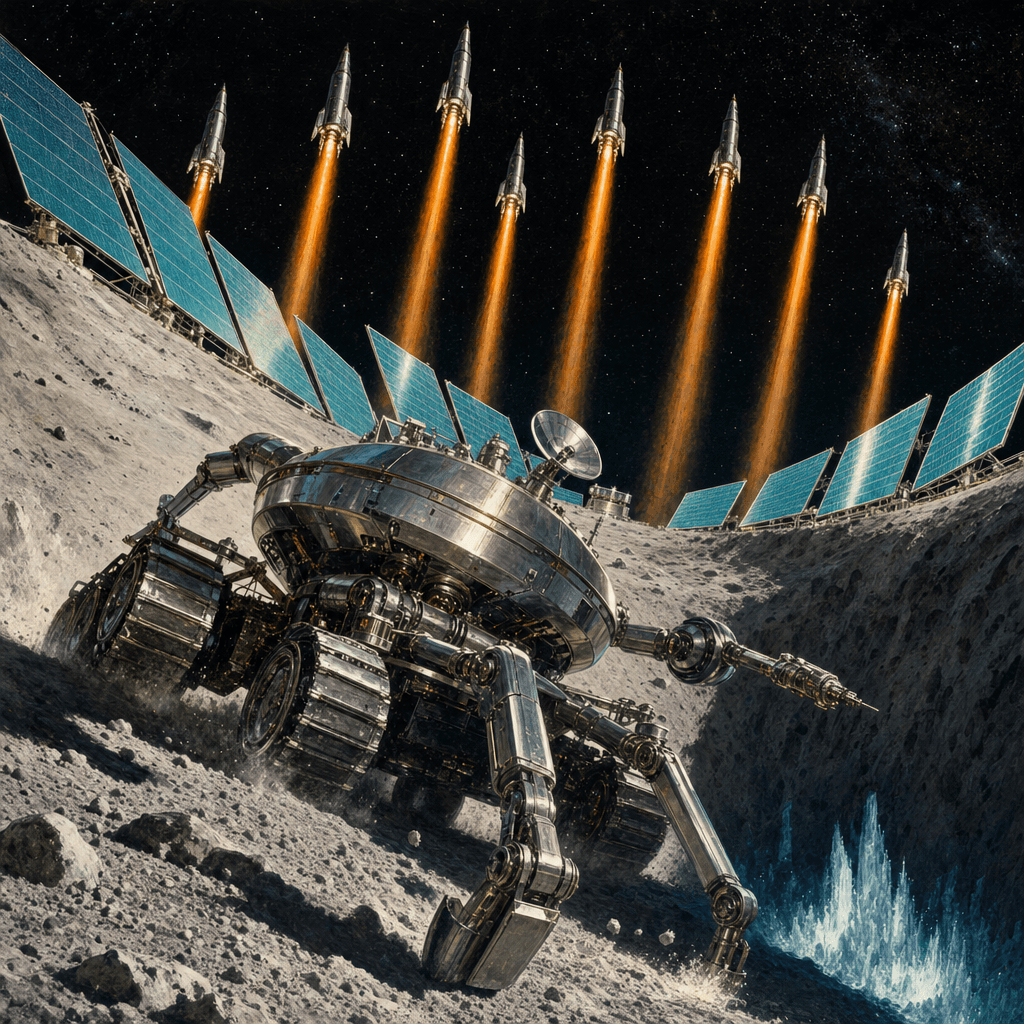
NASA's Commercial Lunar Payload Services 2.0 (CLPS 2.0) program awarded 1.3 billion USD in lunar delivery contracts across eight providers in November 2026, simultaneously greenlighting the Polar Resources Ice-Mining Experiment (PROMISE) rover — and for anyone tracking surface power on the Moon, the combination of delivery capacity and resource-prospecting hardware is the most consequential pairing since Artemis I flew in 2022.
What does CLPS 2.0 actually change for lunar surface power?
The contract structure matters here. By naming eight providers rather than consolidating on one or two, NASA is building redundancy into the delivery pipeline — which is exactly what a nascent lunar surface power ecosystem requires. A single launch failure cannot strand every surface power experiment if payloads are distributed across Astrobotic, Intuitive Machines, and six other competitors. NASA described the approach as "building the Moon Base mission by mission," a phrase that telegraphs incremental, payload-by-payload infrastructure growth rather than a single monolithic deployment. For program officers writing surface power roadmaps, this means delivery slots will exist — the question is whether photovoltaic (PV) array and power management payloads can be ready to fill them.
The PROMISE rover approval sits squarely in that context. Ice prospecting at the lunar south pole is not an abstract science objective: water ice is both a potential propellant feedstock and a constraint on where permanent surface power infrastructure can be sited. If PROMISE confirms accessible ice concentrations in permanently shadowed regions (PSRs), it narrows the trade space for where to anchor solar arrays on the sunlit crater rims that ring those PSRs — a siting problem every surface power designer is currently solving on paper.
What technology is feeding into the solar array supply chain?
One answer came the same week from Sydney. SunDrive Solar and Space Machines Company announced a collaboration to develop Australian-made spacecraft solar arrays using SunDrive's copper-based photovoltaic cell technology in November 2026. The cost advantage: copper substitution reduces material volatility compared to incumbent silver-based cells, which carry supply-chain exposure that program managers already price into risk registers. SunDrive and Space Machines Company have not yet published specific power (W/kg) or end-of-life efficiency figures for their space variant, and no peer-reviewed data has been released on radiation tolerance for the copper cell architecture in a space environment. That absence is the key caveat. A terrestrial efficiency record does not transfer directly to a vacuum-and-radiation environment; the collaboration is at the development stage, not the flight-heritage stage.
For lunar surface power specifically, specific power matters enormously. Mass delivered to the lunar surface commands a severe cost premium under CLPS pricing structures described in NASA's contract awards, which means every gram of solar array mass must justify itself in watts delivered. Until SunDrive and Space Machines Company publish tested space-cell performance numbers, this remains a technology readiness level (TRL) story, not a procurement story.
What the $1.3B award does and does not prove
This milestone sits on the demo-to-deployment curve as follows: CLPS 2.0 contract awards prove that NASA has committed delivery budget and selected a credible provider pool. They do not prove that surface power payloads are ready to fly, that the lunar grid architecture is defined, or that any kilowatt has been delivered to a surface load beyond Earth-based testbeds. The NASA Moon Base progress updates shared at Kennedy Space Center in 2026 confirm billions are flowing into the broader program, but the gap between contract award and operational surface power remains wide — measured in years and in unresolved engineering decisions about energy storage for the approximately 14-day lunar night that surface power systems must bridge.
The SunDrive-Space Machines Company collaboration, meanwhile, is a TRL 3-to-4 development bet consistent with the program's own framing as an early-stage technology collaboration: component validation in a laboratory environment, with the goal of demonstrating a viable alternative to incumbent space solar suppliers. If it reaches TRL 6 — prototype demonstration in a relevant environment — it could become a credible option for CLPS 2.0 payload manifests in the late 2020s.
The decision your roadmap needs to make now
If you are a program officer or investor in lunar surface power, the CLPS 2.0 award structure is your delivery calendar. Eight providers with staggered manifests means more frequent launch windows than the original CLPS program offered, and that changes the calculus on when a solar array payload needs to reach flight-ready status. The window is opening faster than the hardware is maturing — which is exactly the signal to accelerate investment in space-qualified PV technology, power management electronics, and the energy storage systems that will carry surface loads through the lunar night.
Created with AI assistance. Editorial oversight: Juergen Ritzek. See our AI disclosure.