Briefing · November 27, 2026
Lunar Surface Power's Nuclear Fork: Fission Reactors in Craters vs. Tritium Betavoltaic Cells
Two nuclear approaches to surviving the 14-day lunar night moved into clearer focus this week — and they solve very different problems.
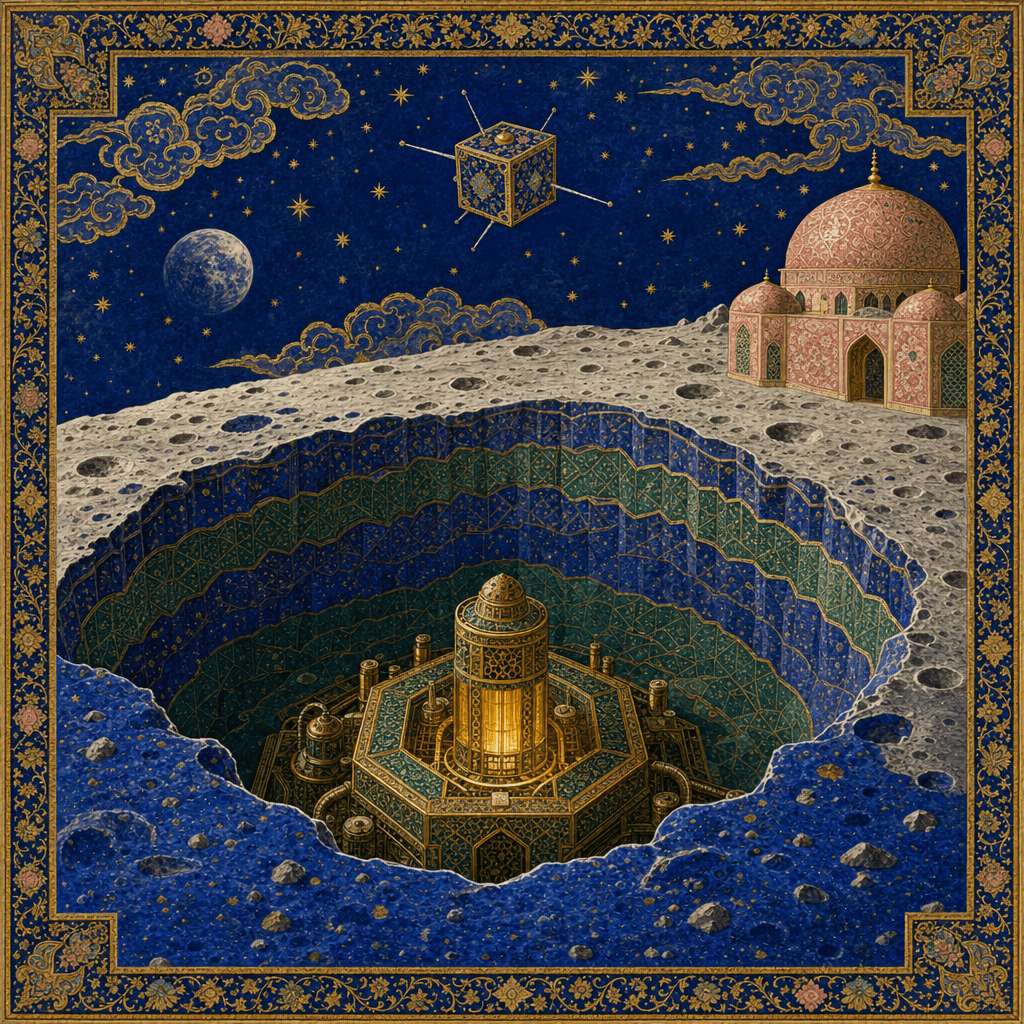
Two distinct nuclear power architectures for the lunar surface are sharpening into real engineering choices this month, and the tradeoffs between them will shape Artemis surface power procurement for the next decade. The core finding is this: a 40 kW fission surface power (FSP) reactor — NASA's current reference design — can shed its heaviest shielding mass entirely by sitting inside a lunar crater rim, while a new class of tritium betavoltaic cells, now being tested in orbit for the first time in 2026, targets the milliwatt-to-watt regime that keeps sensors, comms, and life-support controllers alive through the same 14-day lunar night.
What is a betavoltaic cell, and why does it matter for the Moon?
A betavoltaic cell is a nuclear battery that converts the kinetic energy of electrons emitted during beta decay — in this case from tritium, a radioactive isotope of hydrogen — directly into electrical current, with no moving parts and no heat engine. The device operates continuously regardless of temperature, making it immune to the −173 °C lunar nights that have killed solar-charged batteries on previous missions. IEEE Spectrum (2026-11-25) reports that tritium betavoltaic cells are being tested in space for the first time in 2026 aboard a CubeSat, with the stated aim of supporting long-term electricity generation on the Moon's surface. Power density remains modest — betavoltaics are not load-following generators — but their longevity and near-zero maintenance profile make them credible candidates for the persistent low-power bus that a crewed outpost needs even when the main reactor is offline.
Can lunar craters realistically replace radiation shielding mass?
Yes, within specific geometry constraints, and the mass savings are the reason the idea is worth engineering attention. Fission reactors produce neutron and gamma radiation that must be blocked from crew and sensitive electronics; on Earth, that shielding is concrete or water. On the Moon, regolith works just as well, and crater rims provide meters of it for free. Universe Today (2026-11-25) details the concept around NASA's 40 kW FSP reference reactor: by positioning the reactor below the crater rim line, the regolith wall intercepts the radiation cone, allowing the habitat to be sited on the opposite rim with minimal added shielding mass. The 40 kW figure is not arbitrary — NASA's Artemis surface power roadmap targets that level as the minimum threshold for a sustained four-person outpost, covering life support, science instruments, and in-situ resource utilization (ISRU) equipment simultaneously.
The mass argument deserves a hard look. Every kilogram of shielding not launched to the Moon is a kilogram freed for payload or structural margin. With current heavy-lift costs still running in the thousands of USD per kilogram to lunar surface, even a one-tonne shielding reduction translates to tens of millions of dollars in avoided launch cost — before accounting for the operational complexity of assembling heavy shielding structures in a 1/6-g vacuum environment with suited crew.
Where each technology sits on the demo-to-deployment curve
The FSP reactor remains at Technology Readiness Level (TRL) 4–5 as of late 2026 — component-level validation, with no full-system space demonstration yet. The crater-shielding concept is a mission architecture proposal, not a hardware milestone; it reduces landed mass on paper but needs site-survey data, slope-stability analysis, and robotic emplacement validation before it can be called a credible deployment option. The Universe Today (2026-11-25) coverage presents this as a conceptual study, not a contracted design phase.
The tritium betavoltaic cells are further along in one narrow sense: they are in orbit in 2026, generating data. That puts them at TRL 7 for the space environment. What they have not yet demonstrated is long-duration surface operation under lunar thermal cycling, regolith dust accumulation, and the specific radiation environment at the lunar south pole. IEEE Spectrum (2026-11-25) notes the CubeSat test is designed to validate survival through the space environment as a precursor to surface deployment.
What this means for your roadmap
Program officers evaluating lunar surface power architectures should treat these two technologies as complementary layers, not competing bids. A betavoltaic low-power bus — sized in the tens of watts — can hold critical systems through any FSP maintenance window or unplanned shutdown, at a mass and complexity cost that is negligible relative to the main reactor system. The crater-siting concept, meanwhile, is worth funding at the site-survey and robotic-emplacement study level now, because the alternative — shipping dedicated radiation shielding to the Moon — becomes prohibitively expensive at any launch cadence the current manifest supports. The 40 kW FSP design needs a shielding answer before it can be called a deployable system, and regolith is the only answer with a realistic mass budget.
Created with AI assistance. Editorial oversight: Juergen Ritzek. See our AI disclosure.