Briefing · October 7, 2026
Lunar Laser Clocks and 1,000 MHz of New Spectrum: What Changed This Week for Space Power and Navigation
A lunar optical clock proposal and 1,000 MHz of freshly opened FCC spectrum could reshape navigation and power-beaming infrastructure for cislunar operations.
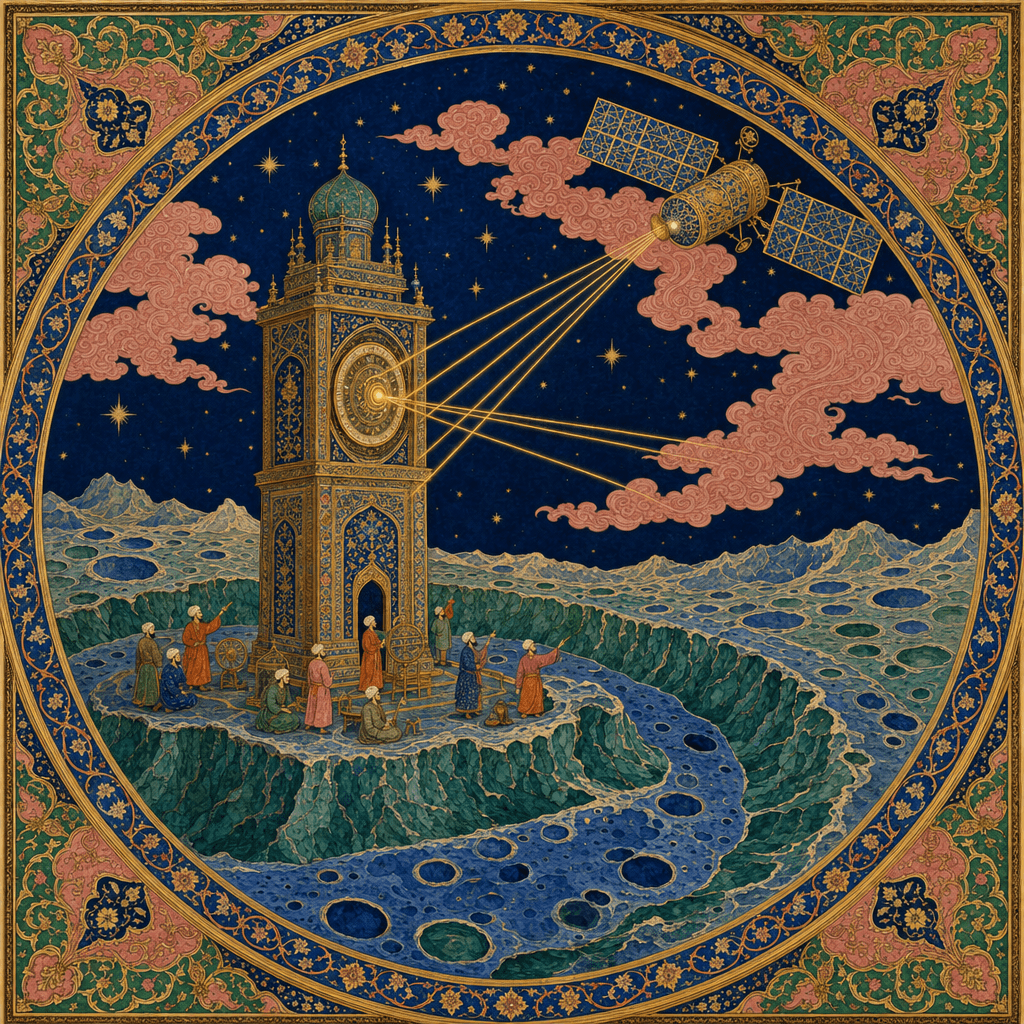
Two developments this week deserve a place on the roadmap of anyone building infrastructure beyond low Earth orbit (LEO): a research proposal for laser-based timekeeping at the lunar south pole, and a U.S. Federal Communications Commission (FCC) vote that simultaneously exempts satellite licensing from environmental review and opens 1,000 MHz of new spectrum. Neither item is a deployed system, but together they move two long-standing cislunar bottlenecks — timing infrastructure and radio-frequency (RF) access — measurably closer to resolution.
What exactly did the FCC open, and who benefits?
In an October 2026 vote, the FCC opened 1,000 MHz of spectrum for satellite operations and exempted satellite licensing from National Environmental Policy Act (NEPA) environmental reviews. For space solar and power-beaming programs specifically, the spectrum ruling is the more immediately consequential of the two decisions. Wireless power transmission — whether from an orbital platform to a ground rectenna or from a lunar relay to a surface asset — is a spectrum-access problem before it is an engineering problem. Contested or unlicensed bands have been a credible barrier to commercial power-beaming demonstrations in the United States, and 1,000 MHz of additional headroom, as of October 2026, materially reduces that barrier for operators seeking experimental licenses.
The NEPA exemption cuts a different kind of friction: licensing timelines. Environmental review has historically added months to years to satellite constellation approvals. Removing that step for satellite licensing accelerates the schedule for any operator deploying power-relay or communications-relay satellites — a direct benefit to space-based solar power (SBSP) demonstration programs that need to field hardware in orbit before the decade closes if they are to influence terrestrial grid investment decisions in the 2030s.
What the FCC vote does not do: it does not allocate dedicated power-beaming frequencies, resolve interference coordination with terrestrial 5G operators, or address international spectrum harmonization through the International Telecommunication Union (ITU). Those remain open problems requiring separate regulatory action.
Could a lunar laser network double as positioning infrastructure for surface power assets?
Separately, researchers are proposing that permanently shadowed craters at the lunar south pole host laser-based optical atomic clocks that could serve as a lunar timekeeping standard and navigation reference for spacecraft and surface vehicles, as reported by IEEE Spectrum. The permanently shadowed regions (PSRs) of the lunar south pole offer thermal stability — temperatures in some craters remain below 40 K year-round — which is the physical condition that makes ultra-stable optical cavities practical without the active cooling mass budget that would otherwise be prohibitive.
Here is the plain-language explainer: an optical atomic clock works by locking a laser to the natural oscillation frequency of atoms, which tick billions of times per second — far faster than the microwave frequencies used in conventional GPS atomic clocks. That higher frequency means finer timekeeping resolution and, consequently, tighter position fixes. A network of such clocks on the lunar surface could serve as the timing backbone for a lunar positioning system (LPS) analogous to GPS, enabling centimeter-level navigation for rovers, landers, and surface power infrastructure including cable routing and rectenna alignment.
This is currently a proposal, not a funded program. Technology readiness level (TRL) for a space-qualified optical clock suitable for the lunar thermal environment is not yet cited in the available source, and no launch manifest or cost estimate accompanies the concept. The critical gap between "physically plausible" and "budgeted mission" is not closed. Still, the proposal is directionally important: lunar south pole surface power assets — the same sites targeted by NASA's Fission Surface Power (FSP) program and commercial solar array deployments — need precision navigation to operate autonomously, and a dedicated lunar timing infrastructure would serve that need in a way that Earth-based deep space network (DSN) links, with their multi-second round-trip latency, cannot.
What this means for your next decision
If you are modeling a lunar surface power deployment that depends on autonomous rover operations or precision power-cable installation, the lunar laser clock proposal is worth tracking as an infrastructure dependency — not a near-term input, but a potential cost-avoidance item if a funded LPS emerges before your mission's critical design review. If you are licensing a power-beaming demonstration in the United States, the FCC's October 2026 spectrum and NEPA decisions belong in your regulatory risk register as a net positive that shortens your path to an experimental license — though ITU coordination remains your critical-path item.
Created with AI assistance. Editorial oversight: Juergen Ritzek. See our AI disclosure.