Briefing · September 4, 2026
ESA's MAGPIE Lunar Rover Deal and Artemis III Engine Install Signal a Busy Season for Moon Surface Power Planning
Two concrete milestones — ESA's MAGPIE rover contract and Artemis III RS-25 engine installation — sharpen the timeline for lunar surface power decisions.
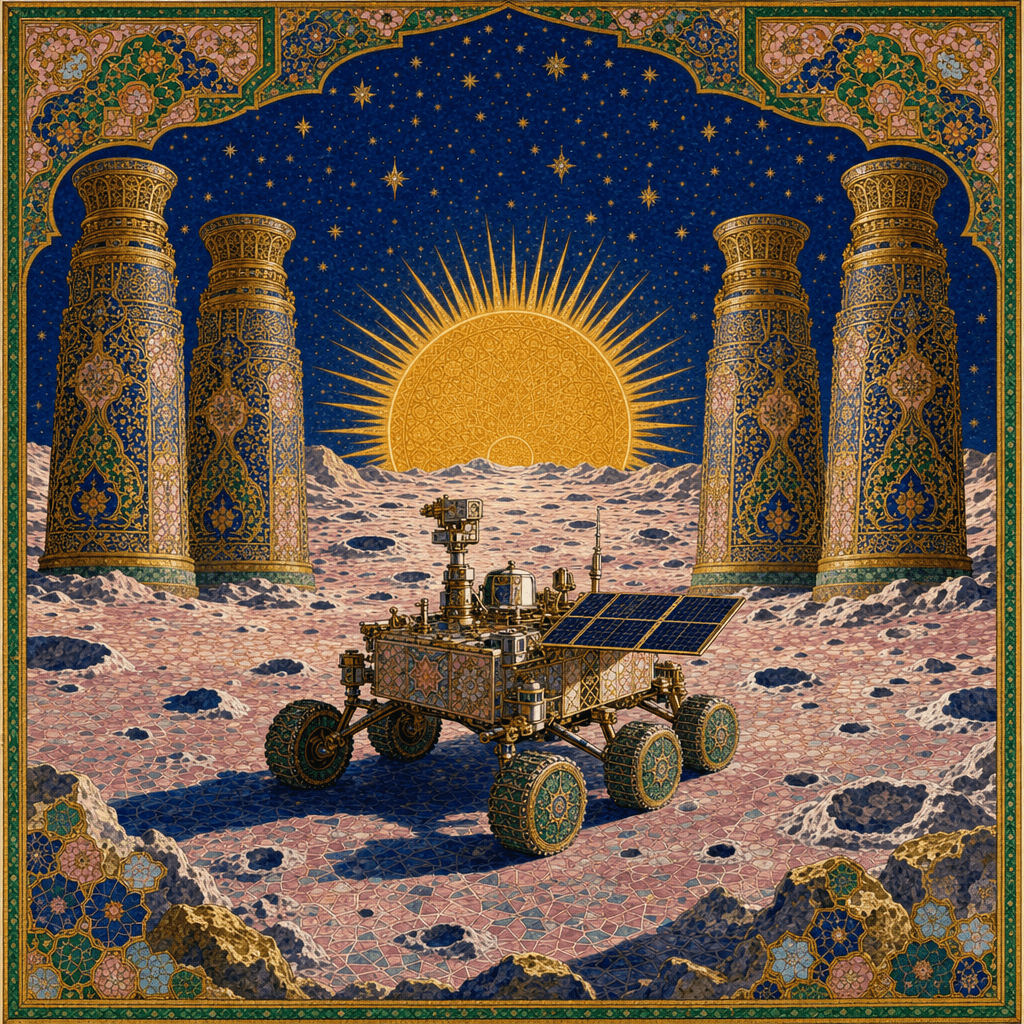
Two milestones landed within days of each other in late August and early September 2026 that, taken together, tighten the window for anyone still treating lunar surface power as a 2030s problem: the European Space Agency (ESA) signed an implementation agreement for its first lunar rover, and NASA technicians bolted four RS-25 engines into the Artemis III core stage at Kennedy Space Center. ESA's MAGPIE rover — contracted with ispace-Europe during a signing ceremony in Copenhagen on the first day of September 2026 — will be the first European-built surface asset on the Moon, and it will need power from day one of surface operations.
What exactly did ESA sign with ispace-Europe, and why does it matter for surface power?
The ESA–ispace-Europe MAGPIE agreement (2026-09-01) formalises MAGPIE as ESA's first lunar rover, moving the programme from study into implementation. That distinction matters on the demo-to-deployment curve: this is no longer a paper concept or a technology readiness level (TRL) 3 breadboard — it is a contracted mission with a delivery obligation. Rover surface operations depend entirely on local power: solar arrays sized for the lunar day, battery or fuel-cell buffers for the terminator, and thermal management across a 300 K swing. ESA has not yet published MAGPIE's specific power budget in watts, but the ispace lunar lander heritage from the Mission 1 attempt in 2023 sets a reference point for the class of system involved. Programme officers building power-beaming or distributed-array proposals for the lunar south pole now have a named, contracted customer to write into their architectures.
When does Artemis III actually launch, and what does the engine installation prove?
On 24 August 2026, technicians at NASA's Kennedy Space Center began installing the four RS-25 engines into the Space Launch System (SLS) core stage that will carry the Artemis III crew, targeting a 2027 launch, according to NASA (2026-08-24). Each RS-25 engine carries a unique serial number logging its prior flight history — a detail that underscores these are refurbished shuttle-era assets, not newly manufactured hardware. What the installation milestone proves is manufacturing and integration sequencing, not orbital performance; SLS has flown once on Artemis I. Meanwhile, NASASpaceFlight.com (2026-08-01) reports that four SLS vehicles are now simultaneously in production, a cadence that had not been achieved before and that implies a realistic crewed lunar surface presence inside a three-year window.
The plain-language context: what is lunar surface power, and why is it hard?
Lunar surface power refers to generating, storing, and distributing electrical energy on the Moon to run rovers, habitats, instruments, and in-situ resource utilisation (ISRU) equipment. The core difficulty is the lunar day-night cycle: at the south pole — the target zone for both Artemis crewed landings and MAGPIE's likely operations area — some crater rims receive near-continuous sunlight, but shadowed regions receive none, and night temperatures fall below -170 °C. A solar array optimised for a permanently illuminated ridge can produce useful power, but energy must be transmitted or stored across distances of hundreds of metres to reach shaded assets. This is the physical gap that power-beaming (microwave or laser) and long-cable distribution concepts are competing to fill. No system has yet demonstrated this capability on the lunar surface at operational scale.
What the combined signal means for your roadmap
The pairing of a contracted ESA rover and a 2027 crewed landing target compresses the timeline for surface power decisions in a concrete way. Any power-beaming or distributed-generation proposal that wants to be on the lunar surface by the time Artemis III crew arrives — or ready for MAGPIE's surface operations — must be past TRL 5 qualification today. Funding timelines for space hardware typically run 18 to 36 months from contract award to flight readiness; the window for inserting new power architecture into either programme is narrowing fast. Separately, NASA's $700 million USD firm-fixed-price contract with Blue Origin for a Mars Telecommunications Network orbiter (2026) signals that NASA is willing to write nine-figure contracts for enabling infrastructure — a precedent that surface power advocates should be citing in their next programme office conversation. The question for investors and programme officers is not whether lunar surface power is needed; it is whether their candidate technology can demonstrate TRL 6 performance before the first crew touches down.
Created with AI assistance. Editorial oversight: Juergen Ritzek. See our AI disclosure.