Briefing · August 4, 2026
Drift-Aware Space Tugs Could Cut Propellant Costs for In-Orbit Servicing Missions
A new trajectory-optimization framework exploits Earth's orbital precession to slash fuel costs for multi-target space tug missions.
What is drift-aware trajectory optimization for space tugs?
Space-based solar power (SBSP) and any large orbital infrastructure — power-relay satellites, orbital data centers, in-space manufacturing nodes — will eventually need servicing. That means tugs. And tugs burn propellant, which means mass, which means launch cost. A new arXiv preprint published in July 2026 attacks exactly that cost driver head-on: a drift-aware multi-target trajectory optimization framework (arXiv, 2026-07) that stops treating Earth's oblateness-induced nodal precession as a nuisance to be cancelled, and starts using it as a free steering resource.
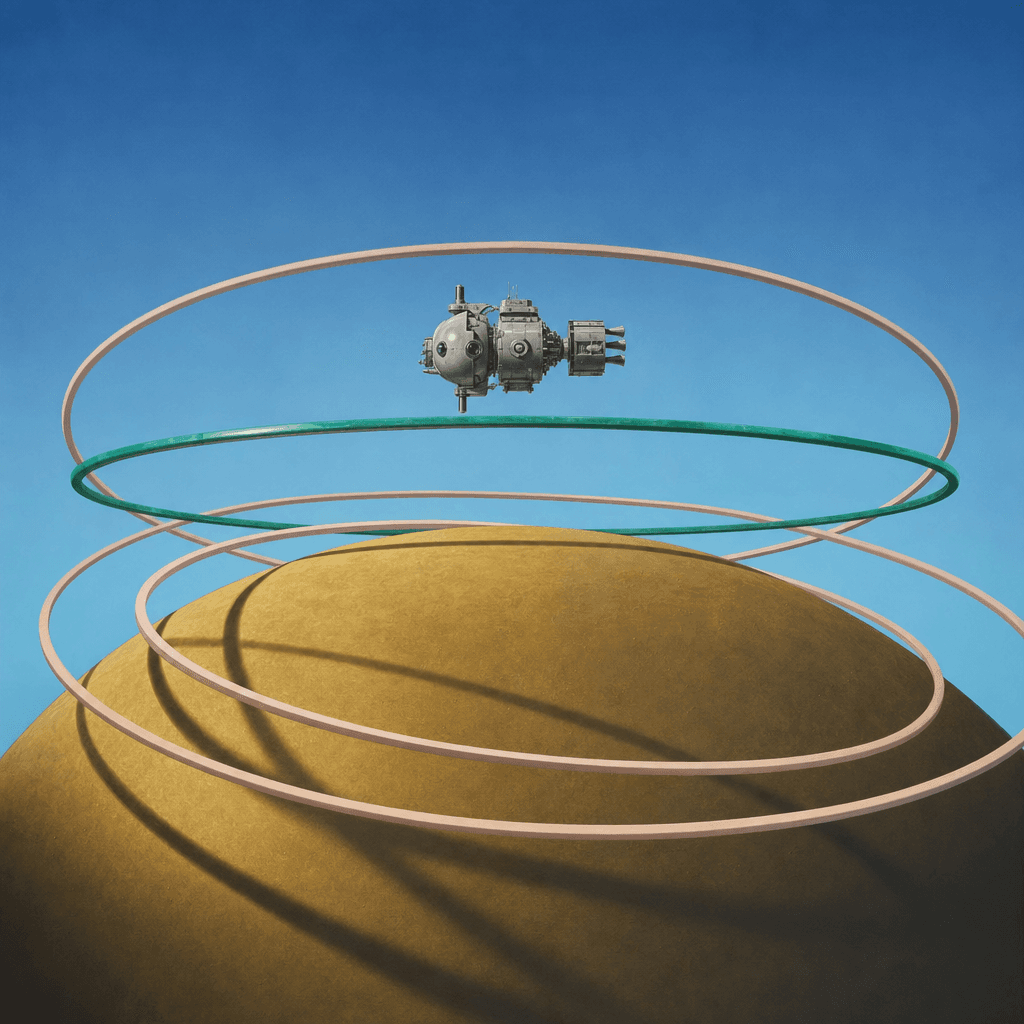
Nodal precession is the slow rotation of an orbit's plane around Earth's polar axis, driven by the planet's equatorial bulge. Classical mission planners burn propellant to fight that drift when visiting multiple targets in different orbital planes. The new framework instead schedules rendezvous windows to arrive after precession has naturally aligned the next target's plane — spending zero delta-V on the plane change itself.
That single reframe is what makes the paper worth reading for anyone budgeting a multi-satellite servicing architecture in 2026.
Why does this matter for orbital power infrastructure?
One sentence that stands on its own: the drift-aware framework developed by researchers and published on arXiv in July 2026 demonstrates that exploiting natural nodal precession — rather than cancelling it with propellant — can reduce propellant costs for multi-rendezvous space tug missions to levels that classical mission design cannot match, potentially unlocking economically viable servicing of large orbital constellations.
The relevance to this readership is direct. SBSP concepts from the European Space Agency (ESA) SOLARIS program and commercial power-beaming ventures all assume large modular structures assembled or maintained in orbit. Orbital data center constellations are facing the same question: as SpaceNews noted in its July 2026 analysis, experts are already calling for rules of the road around constellation safety, which implicitly includes servicing and debris management logistics.
Neither problem is solvable if tug propellant budgets are prohibitive. The drift-aware approach addresses active debris removal and in-orbit servicing simultaneously — two mission types that share the same multi-plane geometry problem. What the paper does not yet prove: an orbital demonstration, a hardware TRL level, or a cost-per-kilogram-saved figure. This is a trajectory-design result, not a flight result. Treat it accordingly.
How does this benchmark against current servicing economics?
The honesty required here is that specific propellant-savings percentages from the paper are not quotable without the full peer-reviewed text, so we will not fabricate a number. What the abstract does establish is that the "prohibitive propellant costs" of classical multi-plane rendezvous are the explicit baseline being improved upon — and that the improvement is benchmarked computationally within the paper's optimization framework.
For context on why this matters economically: launch costs remain the dominant variable in any orbital servicing business case. Blue Origin is currently rebuilding its Cape Canaveral launch complex and will test New Glenn upper stages at NASA's Stennis Space Center, a signal that even well-capitalized launch providers are still in hardware-maturation mode in mid-2026. Meanwhile, a Payload research forecast on next-generation reusable rockets (Payload, 2026-07) projects a slow cadence ramp for vehicles like New Glenn, Neutron, Nova, Terran R, and Eclipse — meaning cheap, high-frequency launch access for heavy tug hardware is still years away.
In that environment, any technique that reduces propellant mass fraction for a servicing mission directly reduces the number of resupply launches required. That is not a minor optimization; it is a potential difference between a viable business model and one that requires perpetual subsidy.
What should program officers and investors do with this now?
The drift-aware framework is at the analysis and simulation stage — no Technology Readiness Level (TRL) assignment is claimed in the abstract. The appropriate action is not to build a servicing constellation around it today. The appropriate action is to include nodal-precession scheduling as a design variable in any multi-target tug architecture study being scoped right now, and to task a trajectory analyst with replicating the benchmark against your specific target constellation geometry.
For SBSP program officers specifically: if your architecture assumes periodic panel replacement or attitude-control module swaps across multiple orbital planes, the delta-V budget in your current cost model may be significantly pessimistic. This paper is the citation you need to justify reopening that line item in the next program review.
The gap between a simulation result and a bankable servicing contract remains wide. But the direction of travel — treating orbital mechanics as an asset rather than a constraint — is the right one.
Created with AI assistance. Editorial oversight: Juergen Ritzek. See our AI disclosure.