Briefing · September 3, 2026
DOE's $12 Million SBSP Bet: What the Fund Proves — and What It Doesn't
The US DOE has opened a $12M R&D fund for space-based solar power, a meaningful signal — but three hard questions still separate a lab demo from a grid asset.
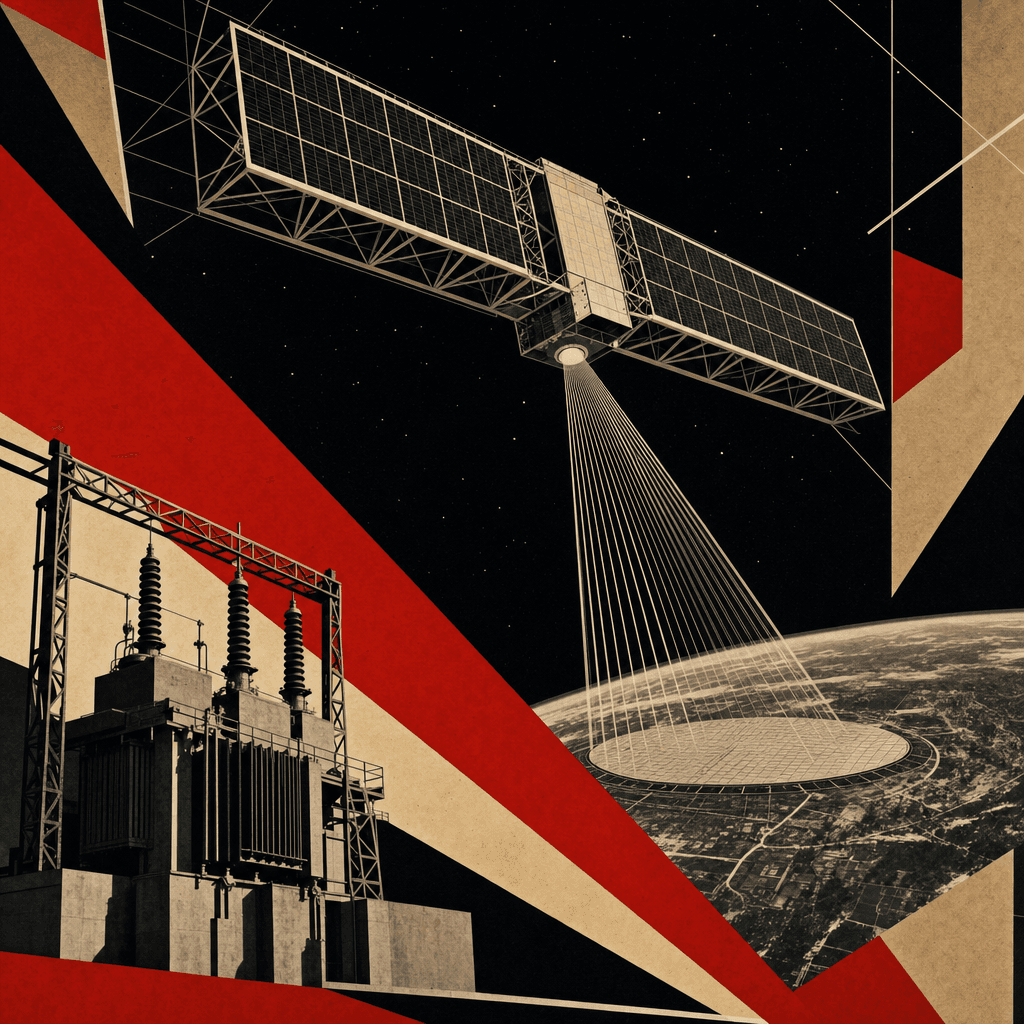
The US Department of Energy (DOE) has formally opened a 12 million USD R&D fund for space-based solar power (SBSP), announced in mid-2025. That number is worth holding in your hand for a moment: 12 million USD is roughly what a utility spends on a single substation transformer. It is not a deployment budget. It is, however, the first time the DOE has put a dedicated line item behind SBSP solar-panel R&D — and for a technology that has spent five decades as a PowerPoint fixture, that institutional signal matters more than the dollar amount alone.
What exactly is space-based solar power, and why does panel technology matter so much?
Space-based solar power is the concept of collecting sunlight in orbit — where there is no night, no weather, and roughly 8 times the average irradiance available at Earth's surface — converting it to electrical power aboard a satellite, then transmitting that power to a ground receiver via microwave or laser. The conversion and transmission chain involves three lossy steps: photovoltaic collection, DC-to-RF (or DC-to-laser) conversion, and rectenna reception on the ground. End-to-end efficiency for the best-demonstrated microwave architectures sits in the 10–20% range today, which means the solar panels themselves must be extraordinarily lightweight and efficient to make the mass budget close at any plausible launch price. Specific power — watts of electrical output per kilogram of panel mass — is the single most important figure of merit, and it is what the DOE fund appears to target.
What does the $12M DOE fund actually buy?
The DOE's 12M USD fund is structured as an R&D grant program aimed at advancing solar panels specifically designed for the space environment: radiation hardness, thermal cycling tolerance, and — critically — specific power. Current high-performance space photovoltaics run roughly 300–400 W/kg at the cell level; SBSP architectures generally require sustained panel-level specific power above 1,000 W/kg to make the mass-to-orbit economics work at any launch cost below roughly 1,000 USD/kg. The fund does not, on its own, close that gap. What it can do is de-risk the next generation of multijunction or thin-film cell architectures enough that a larger follow-on program — think DARPA, DOD, or a full DOE ARPA-E solicitation — has validated technology to pull from.
Place this on the demo-to-deployment curve: it is early-stage materials and component R&D, Technology Readiness Level (TRL) 2–4. It is not a systems demonstration. It is not an orbital pilot. ESA's SOLARIS initiative has similarly been funding sub-system studies, and the UK's Space Energy Initiative has completed a conceptual design for a 2 GW constellation — but neither has yet flown a power-transmitting satellite. The DOE fund slots in at the same pre-flight tier.
How does launch cost fit the economic picture right now?
The economics of SBSP live or die on cost-per-kilogram to geostationary transfer orbit (GTO), and the market just moved. SpaceX currently lifts approximately 85% of all mass placed in orbit globally — roughly 2,400 metric tons per year, a concentration that has no precedent in the launch industry. Starship, targeting sub-100 USD/kg to low Earth orbit (LEO) at scale, would be the single largest enabler of SBSP economics if those prices materialise at volume. The caveat every SBSP analyst must carry: GTO costs 3–5× more than LEO, and a commercial SBSP plant likely requires hundreds of heavy-lift launches. No credible cost model closes below roughly 5 USD/kWh at the grid without both Starship-class pricing and the specific-power improvements the DOE fund is trying to catalyse. Those are two large simultaneous bets.
The benchmark the DOE's awardees must beat is not last year's coal plant — it is utility-scale solar-plus-storage, now routinely contracted in the US Southwest below 0.04 USD/kWh. SBSP's value proposition is firm, dispatchable, location-independent power, not cheap electrons. Program officers and investors should structure milestones accordingly: specific power achieved in a ground test, then a thermal-vacuum chamber result, then a rideshare demonstration of the panel module, then a power-transmission demo in orbit. The 12 million USD fund can credibly deliver the first two. The rest of the roadmap still requires a sponsor willing to write a much larger check.
For your immediate decision: if you are evaluating SBSP partnerships or supply-chain investments, the DOE solicitation documents will define the specific-power and radiation-tolerance targets the agency considers credible — those numbers are your due-diligence baseline for every vendor pitch you receive this year.
Created with AI assistance. Editorial oversight: Juergen Ritzek. See our AI disclosure.