Briefing · October 2, 2026
Cornell's Orbital Lightsail Demos Raise a Hard Question for In-Space Power
Cornell students deployed two free-flying lightsails aboard the ISS — here's what it actually proves, and what it doesn't, for in-space propulsion and power.
What did Cornell's lightsail experiment actually demonstrate in orbit?
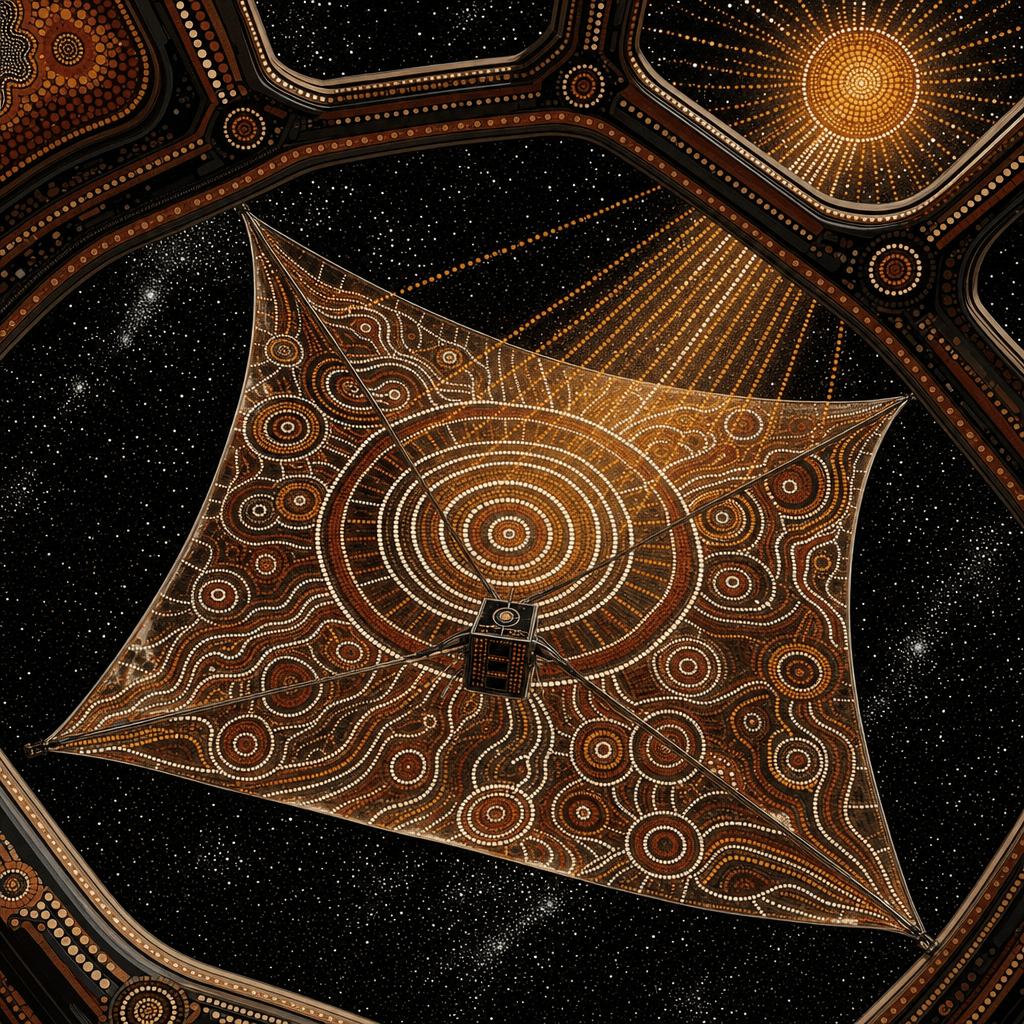
Cornell University's Space Systems Design Studio has published results from two in-orbit lightsail experiments — Alpha CubeSat and Sailing to the Stars — conducted aboard the International Space Station (ISS), marking one of the few student-led programs to achieve free-flying sail deployment in the orbital environment. According to Universe Today (2026-09-30), the AlphaCube satellite unfurled its sail within the ISS's Cupola module, with imagery confirmed by NASA and Rhodium Scientific. That is the milestone on the table: a controlled, in-orbit deployment of a lightsail membrane, verified by external observation — not a propulsion measurement, not a power transmission result, and not a system-level interstellar precursor.
Placing this on the demo-to-deployment curve is essential. Sail deployment is a necessary but not sufficient condition for any photon-pressure propulsion or solar-radiation-pressure maneuvering mission. What Cornell's team proved, in the 2026 ISS campaign, is that a student-built CubeSat-class sail structure can survive the deployment sequence in microgravity. What it has not yet proved: sustained acceleration data, attitude control under photon pressure, or the specific areal density (grams per square meter) needed to benchmark the sail against theoretical interstellar mission requirements.
The technology in plain language. A lightsail works by reflecting photons — particles of light — from the Sun. Because photons carry momentum, a sufficiently large, low-mass reflective membrane can be pushed through space without propellant. The key figure of merit is specific areal density: the lower the mass per unit area (measured in g/m²), the greater the acceleration achievable per unit of solar flux. For reference, Breakthrough Starshot's interstellar concept targets areal densities below 1 g/m² — a threshold no orbital mission has yet demonstrated at meaningful scale.
Why does this matter for power in space, not just propulsion?
The lightsail community and the in-space power community share a critical dependency: ultra-thin, high-reflectance or high-absorptance film technology. Solar power satellites (SPS) and power-beaming spacecraft require large-area photovoltaic or concentrating structures deployed reliably in orbit. Every successful large-structure deployment — whether a reflective sail or a photovoltaic blanket — advances the manufacturing, packaging, and deployment mechanisms that underpin both missions.
Cornell's dual-experiment approach (Alpha CubeSat plus Sailing to the Stars, as reported by Universe Today (2026-09-30)) provides two independent data points on deployment reliability at CubeSat scale. For engineers designing deployable photovoltaic arrays for lunar surface power or orbital power-beaming platforms, the relevant question is not "did the sail open?" but "what was the fold-line failure rate, what were the wrinkle modes, and what areal mass did the packaged structure achieve?" Those numbers are not yet in the public record from this campaign, and readers building roadmaps should treat the Cornell result as a positive deployment confirmation, not a specific-power benchmark.
What does this mean for the Artemis surface power roadmap?
The timing of the Cornell publication coincides with active Artemis Accords governance activity: a Principals' Meeting in Turkey, led by NASA Deputy Administrator Matt Anderson and Maj. Gen. Roberto Melgar Sheen, director of the Peruvian Space Agency, is addressing lunar debris and emerging space support, according to Payload Space (2026-09-25). The agenda items — lunar debris and norms for emerging space nations — are directly relevant to surface power infrastructure. Any long-duration power asset on the lunar surface, whether a fission surface power (FSP) unit or a large-area photovoltaic array, will need internationally agreed protocols for proximity operations, asset protection, and debris avoidance.
For executives and program officers tracking the Artemis surface power schedule, the Accords meeting represents a governance milestone that sits upstream of any hardware deployment decision. Without consensus on who owns the exclusion zone around a power plant at the lunar south pole, bankable power infrastructure on the Moon remains a technical exercise, not an investment case.
The implication for your next decision
If you are evaluating in-space deployable structure suppliers, Cornell's 2026 ISS lightsail result is a useful, low-cost data point on CubeSat-class membrane deployment — but do not extrapolate it to megawatt-scale arrays without the areal density and deployment reliability figures that the team has not yet released publicly. Watch for the peer-reviewed publication. If your roadmap depends on lunar surface power, the Artemis Accords Principals' Meeting in Turkey is the governance event to track this quarter: the norms set there will define the operational envelope for every surface asset that follows.
Created with AI assistance. Editorial oversight: Juergen Ritzek. See our AI disclosure.