Briefing · August 25, 2026
China's Chang'e-7 and NASA's Cargo Landers: Who Powers the Lunar South Pole First?
Two competing programs are racing to deliver sustained power to the lunar south pole — and the infrastructure choices made now will define who operates there.
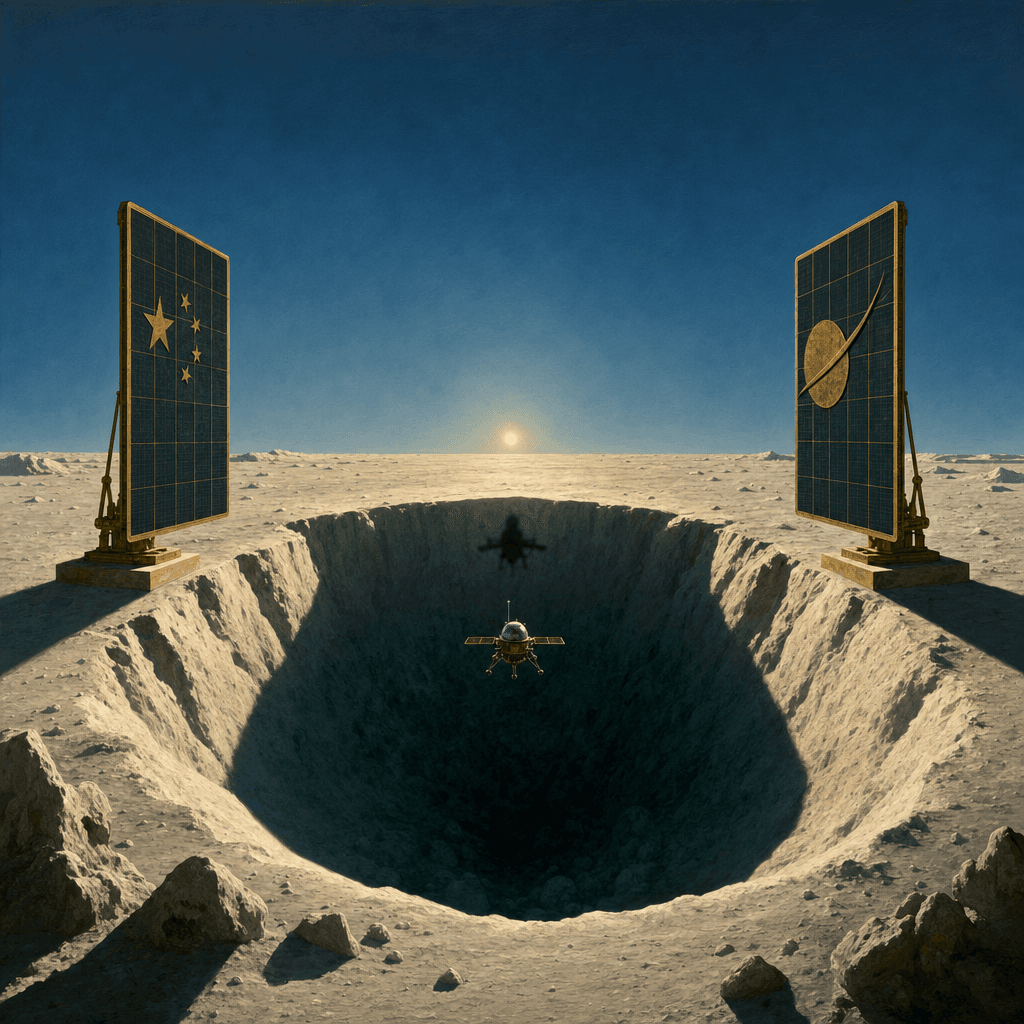
What is actually being built for the Moon right now?
Surface power for the Moon is no longer a whitepaper exercise. NASA highlighted its next-generation cargo lander program in August 2026, framing commercial heavy-lift landers explicitly as the backbone of a permanent lunar base — meaning the agency is betting that multi-tonne payload delivery to the south pole is the near-term rate-limiting factor for sustained human presence, not propulsion or life support. Separately, China's Chang'e-7 mission was confirmed for launch in 2026, targeting Shackleton Crater's rim near the lunar south pole with a multi-spacecraft stack that includes an orbiter, lander, rover, and a small flying probe designed to sample permanently shadowed regions.
The core finding that frames this competitive moment: China's Chang'e-7 mission, targeting the lunar south pole's Shackleton Crater in 2026 with a four-element spacecraft stack, and NASA's commercial next-generation cargo lander program are both converging on the same geography for the same resource — water ice that could be electrolyzed into hydrogen and oxygen, enabling closed-loop power and propellant production on the surface.
Why does the south pole matter for power specifically?
Lunar surface power (LSP) — the generation, storage, and distribution of electrical energy on the Moon's surface — depends heavily on site selection. Near the equator, a solar array faces a 14-Earth-day lunar night with no sunlight whatsoever, demanding enormous battery or fuel-cell storage to bridge the gap. The south pole's elevated ridgelines and crater rims receive near-continuous solar illumination — some peaks see sunlight more than 80% of the time — which dramatically reduces storage requirements and improves the economics of photovoltaic arrays. That is why both programs are converging there.
Chang'e-7's target, Shackleton Crater, sits almost exactly at 90° south latitude. Its rim is among the most persistently illuminated terrain on the Moon, while its floor is permanently shadowed and widely believed to harbor water ice deposits. A mission that can operate on the rim and sample the floor simultaneously — as Chang'e-7's flying mini-probe is designed to do — would characterize both the power resource and the feedstock resource in a single campaign.
What does NASA's cargo lander program actually enable?
NASA's next-generation cargo landers, as described in August 2026, are designed to deliver large, unpressurized payloads to the lunar surface — the class of cargo that includes fission surface power systems, large solar array segments, and electrolysis hardware. The agency's fission surface power project, developed with the Department of Energy, targets a 10 kW (kilowatt) demonstration unit for the Moon; that figure matters because it represents a threshold above which sustained human surface operations become plausible without continuous resupply of consumables. Cargo lander capacity — measured in tonnes to surface — is the direct bottleneck: a 10 kW fission reactor and its shielding and power management hardware masses in the range of several tonnes, which only next-generation landers in the multi-tonne class can accommodate.
The program's August 2026 communications push signals that NASA is trying to synchronize public milestones with the Artemis cadence — but the gap between "highlighting progress" and a contracted delivery date with a mass-to-surface specification remains wide. Readers evaluating partnership or investment timing should note that the lander program is still in the technology readiness level (TRL) advancement and contract maturation phase, not at flight-hardware delivery.
What this means for your roadmap
The competitive pressure from Chang'e-7 is real and near-term. If China successfully characterizes ice in Shackleton's permanently shadowed regions in 2026, it will hold the most detailed subsurface resource map of the south pole — a significant positional advantage for siting future power and propellant infrastructure. NASA's commercial lander ecosystem, by contrast, offers more open architecture for international and commercial partners, but payload delivery to the surface at the multi-tonne scale remains at least several years away from routine cadence.
For executives and program officers deciding on lunar surface power investments today: the site-selection data gap is the most underappreciated risk. Power system designs — array sizing, cable routing, fission shield standoff distances — are all sensitive to the actual terrain and ice distribution at candidate sites. Chang'e-7's reconnaissance data, if shared or published, could become the most valuable free input to any south pole power architecture study conducted through 2030. If it is not shared, the asymmetry of knowledge between the two programs will compound with every subsequent mission.
The race to the south pole is not primarily about flags — it is about who holds the resource and terrain data that makes power plant siting possible.
Created with AI assistance. Editorial oversight: Juergen Ritzek. See our AI disclosure.