Briefing · November 17, 2026
China Puts Three Perovskite Solar Architectures in Orbit — What It Means for Space Power
Beijing-based Yanhe Technology's LEO flight test of perovskite-silicon tandem, perovskite-CIGS tandem, and flexible single-junction modules is the most direct challenge yet to III-V dominance in space PV.
What did Yanhe Technology actually launch, and why does it matter?
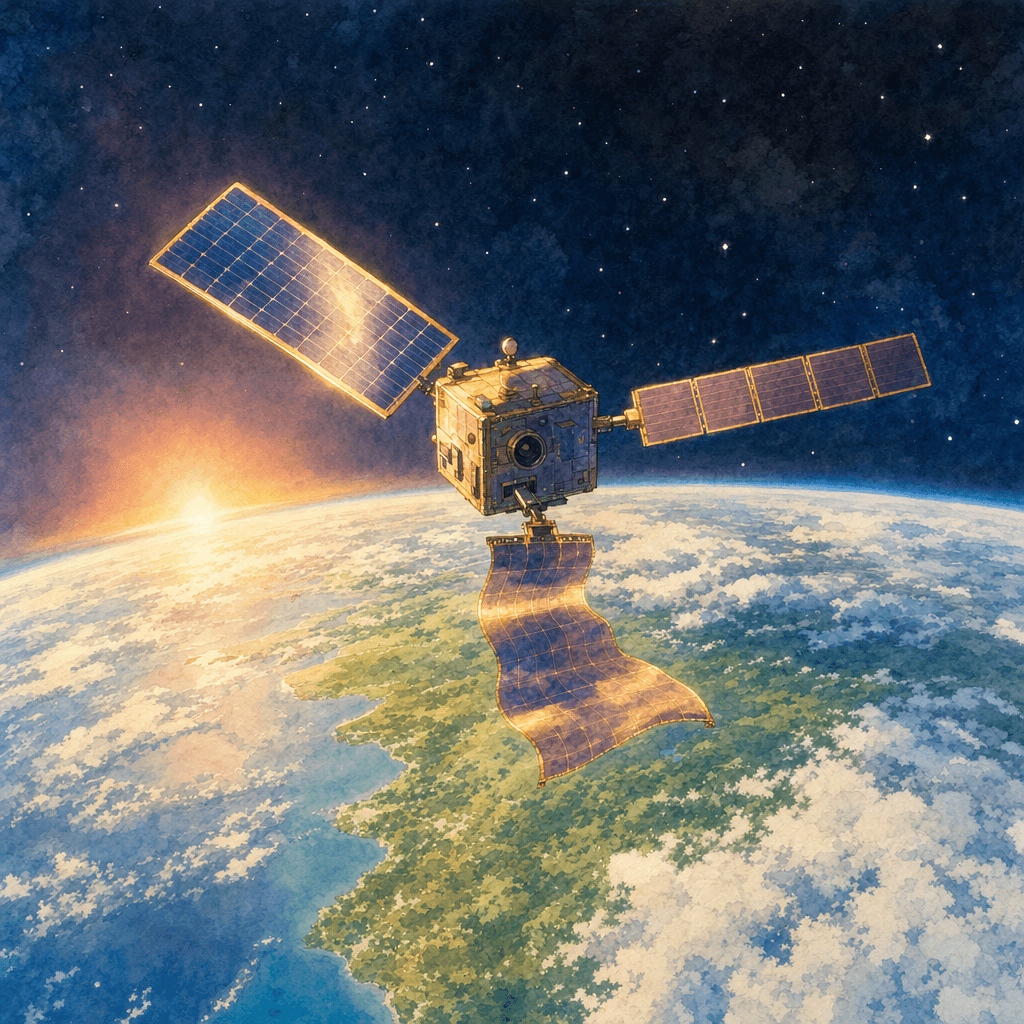
Beijing-based Yanhe Technology has launched three distinct perovskite-based photovoltaic module architectures into low Earth orbit (LEO) to assess their performance under real space conditions, according to PV Magazine (2026-11-14). The three technologies under test are a perovskite-silicon tandem, a perovskite-CIGS (copper indium gallium selenide) tandem, and a flexible single-junction perovskite module. In a single rideshare slot, Yanhe Technology has put more perovskite solar architectures into orbit simultaneously than any previously reported mission — a data-collection strategy that compresses years of sequential testing into one flight campaign.
That sentence stands on its own: Yanhe Technology's November 2026 LEO mission is testing perovskite-silicon tandem, perovskite-CIGS tandem, and flexible single-junction perovskite modules in parallel, the first known multi-architecture perovskite space PV experiment. For engineers and program officers building the specific-power (watts per kilogram, W/kg) roadmaps that determine whether space-based solar power (SBSP) or high-power satellite buses become cost-competitive, this flight is a milestone worth tracking — not because perovskites have proven themselves, but because this is exactly the kind of orbital demonstration that moves a technology from "promising lab result" to "flight-heritage candidate."
What is perovskite solar, and why is it being tested in space?
Perovskite solar refers to photovoltaic cells that use a crystal structure with the chemical formula ABX₃ — most commonly a lead-halide compound — as the light-absorbing layer. In plain terms, perovskites can be deposited as thin films at low temperature, making them candidates for lightweight, flexible solar arrays that could dramatically improve the specific power (W/kg) of space power systems compared with the rigid, expensive III-V multi-junction cells that have dominated spacecraft for decades. Higher specific power directly reduces launch mass per kilowatt delivered, which is the single largest cost lever in any SBSP or high-power satellite architecture. The unresolved question for space applications has always been radiation tolerance and thermal-cycling stability — which is precisely what an orbital soak test is designed to measure.
Where does this sit on the demo-to-deployment curve?
Squarely at the "orbital characterisation" rung — well above a lab demo, but several rungs below flight heritage. The mission will generate real degradation data under the ultraviolet flux, charged-particle radiation, and thermal cycling (roughly −170 °C to +120 °C) of LEO, conditions no ground chamber fully replicates. What it does not yet prove: radiation-hardened encapsulation at scale, 15-year end-of-life performance, or manufacturability at the array sizes needed for multi-kilowatt satellite buses, let alone the multi-gigawatt arrays that SBSP concepts require.
The comparison class matters here. Triple-junction gallium arsenide cells — the current standard — routinely deliver 28–32% beginning-of-life efficiency in space and have decades of on-orbit heritage, but they cost roughly 100× more per unit area than silicon and require complex epitaxial growth. Perovskite-silicon tandems have reached above 33% efficiency in terrestrial lab records, and their low-cost deposition routes are what make the specific-power arithmetic interesting. The gap between a lab record and a flight-qualified product, however, is where most contenders in this field have stalled.
What should space power planners do with this data?
Three things. First, request the raw degradation telemetry when Yanhe Technology publishes results — the relative performance of the tandem vs. single-junction architectures under particle radiation will be the most decision-relevant number this mission produces. Second, benchmark any perovskite specific-power claim against the current III-V standard: a credible improvement needs to show at least 300–500 W/kg at array level (not cell level) to shift procurement calculus for high-power GEO buses, let alone SBSP pilot demonstrators. Third, watch whether a European or U.S. program office responds with a competing orbital test; the PV Magazine (2026-11-14) report notes no equivalent multi-architecture Western mission currently on manifest.
The Yanhe Technology mission does not validate perovskites for space. It does, for the first time, put multiple perovskite architectures in the radiation and thermal environment that is the only honest judge — and that is the right next step for a technology that has spent too long being evaluated exclusively in earthside chambers.
Created with AI assistance. Editorial oversight: Juergen Ritzek. See our AI disclosure.