Briefing · November 24, 2026
Blue Origin's Lunar Prospector Gets €8M GomSpace Contract — What It Means for Moon Surface Power
GomSpace's €8M Phase 2 contract to build two lunar prospecting satellites for Blue Origin marks a concrete step toward mapping the resources any surface power system will depend on.
What Just Happened With the GomSpace Lunar Contract?
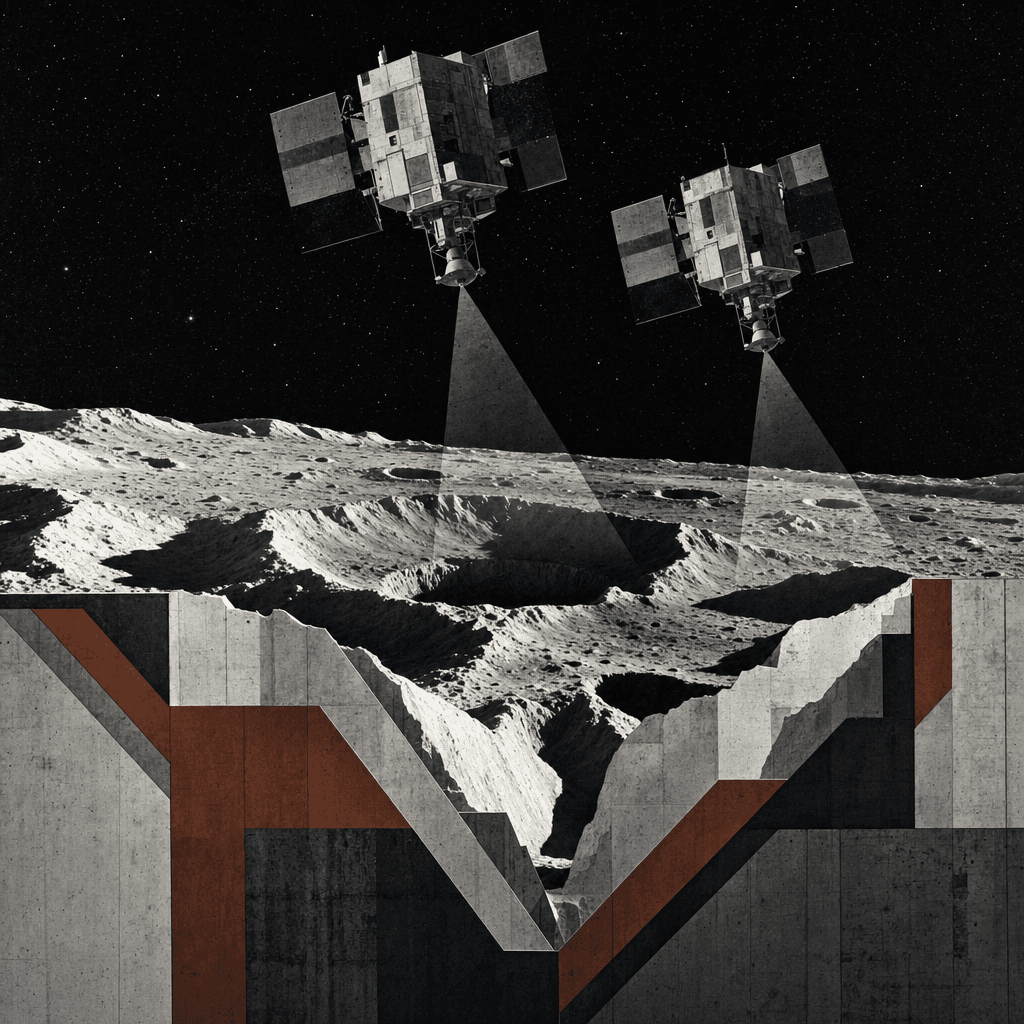
Danish small-satellite manufacturer GomSpace secured an €8 million Phase 2 contract, announced 19 November 2026, to continue developing two spacecraft for a lunar resource prospecting mission. GomSpace publicly identified the customer only as a "leading North American" space company, but European Space Flight (2026-11-19) confirmed the customer is Blue Origin. The dual-satellite architecture is designed to map lunar surface resources — an enabling prerequisite for any sustained human or robotic presence on the Moon, including surface power infrastructure.
This is a Phase 2 contract, which matters: Phase 1 de-risked the mission concept; Phase 2 funds hardware development and integration. That places this program at approximately Technology Readiness Level (TRL) 4–5 — moving from validated concepts to prototype subsystems. It is not a deployed system. It is not a bankable power asset. It is, however, the kind of funded, contracted engineering work that separates a PowerPoint roadmap from an actual spacecraft on a pad.
Why Does Lunar Prospecting Matter to Surface Power Planners?
Surface power on the Moon — whether solar arrays, fission reactors, or beamed power relays — depends entirely on knowing where to put them. Permanently shadowed regions near the lunar south pole are strong candidates for water ice, which is critical for propellant and life support, but those same craters receive no sunlight. Ridgelines and peaks of near-permanent illumination, by contrast, receive solar flux for up to 90% of the lunar day and are the preferred sites for photovoltaic arrays. You cannot design a surface power architecture without a precise resource map, and that is exactly what this dual-satellite mission is intended to produce.
Blue Origin's interest here is strategic. The company is developing its Blue Moon lander for crewed and cargo missions, and any persistent lunar outpost requires a power budget that surface prospecting data will directly inform. The €8 million Phase 2 value is modest relative to the downstream infrastructure decisions it enables.
What Does a Lunar Prospecting CubeSat Actually Do?
Lunar resource prospecting satellites are small spacecraft — often in the CubeSat or microsat class — equipped with spectrometers, radar altimeters, or neutron detectors to identify water ice, mineral compositions, and terrain topology from low lunar orbit. GomSpace, based in Aalborg, Denmark, specialises in small satellite platforms and has heritage from prior missions in low Earth orbit (LEO). Applying that platform expertise to cislunar space is a non-trivial step: lunar orbit presents different radiation environments, communication geometries, and orbital perturbations compared to LEO. The dual-satellite formation also suggests the mission may exploit synthetic aperture or bistatic radar techniques, which improve subsurface ice detection resolution — though GomSpace has not publicly confirmed the payload manifest.
The architecture — two spacecraft rather than one — adds redundancy and potentially enables stereo or interferometric observations, both of which increase data confidence for resource mapping. For surface power planners, higher-confidence maps reduce site-selection risk and, ultimately, capital deployment risk.
What the Competitive Landscape Looks Like Right Now
The lunar prospecting space is not empty. NASA's Lunar Reconnaissance Orbiter has been in operation since 2009 and has produced the most detailed maps of lunar surface illumination and terrain to date. Commercial entrants are now adding higher-resolution, targeted data products. Meanwhile, China has set out its most detailed roadmap yet for landing astronauts on the Moon before 2030, and that program includes its own surface resource and power planning. The geopolitical dimension of lunar resource mapping is now inseparable from the engineering one.
For investors and program officers tracking the Artemis surface power roadmap, the GomSpace-Blue Origin contract is a signal worth logging for three reasons. First, it shows Blue Origin is funding the data layer, not just the lander — a sign of architectural seriousness. Second, a European small-satellite integrator winning a contract from a U.S. commercial lunar customer reflects the maturing international supply chain for cislunar missions. Third, Phase 2 contract execution has a natural forcing function: hardware delivery milestones will determine whether this mission stays on a credible timeline toward a launch in the late 2020s. Watch the Phase 2 completion announcement and the launch vehicle selection — those will be the next decision-relevant data points for anyone building surface power business cases around lunar south pole sites.
Created with AI assistance. Editorial oversight: Juergen Ritzek. See our AI disclosure.