Briefing · August 26, 2026
Beyond Reach Labs' Flarewing and ESA's Nuclear Argonaut Signal a Surface Power Reckoning
Two milestones this week—a patent-pending deployable solar array and Ariane 6 nuclear safety mods—sharpen the surface power trade-off every lunar program must now make.
What actually changed in lunar surface power this week?
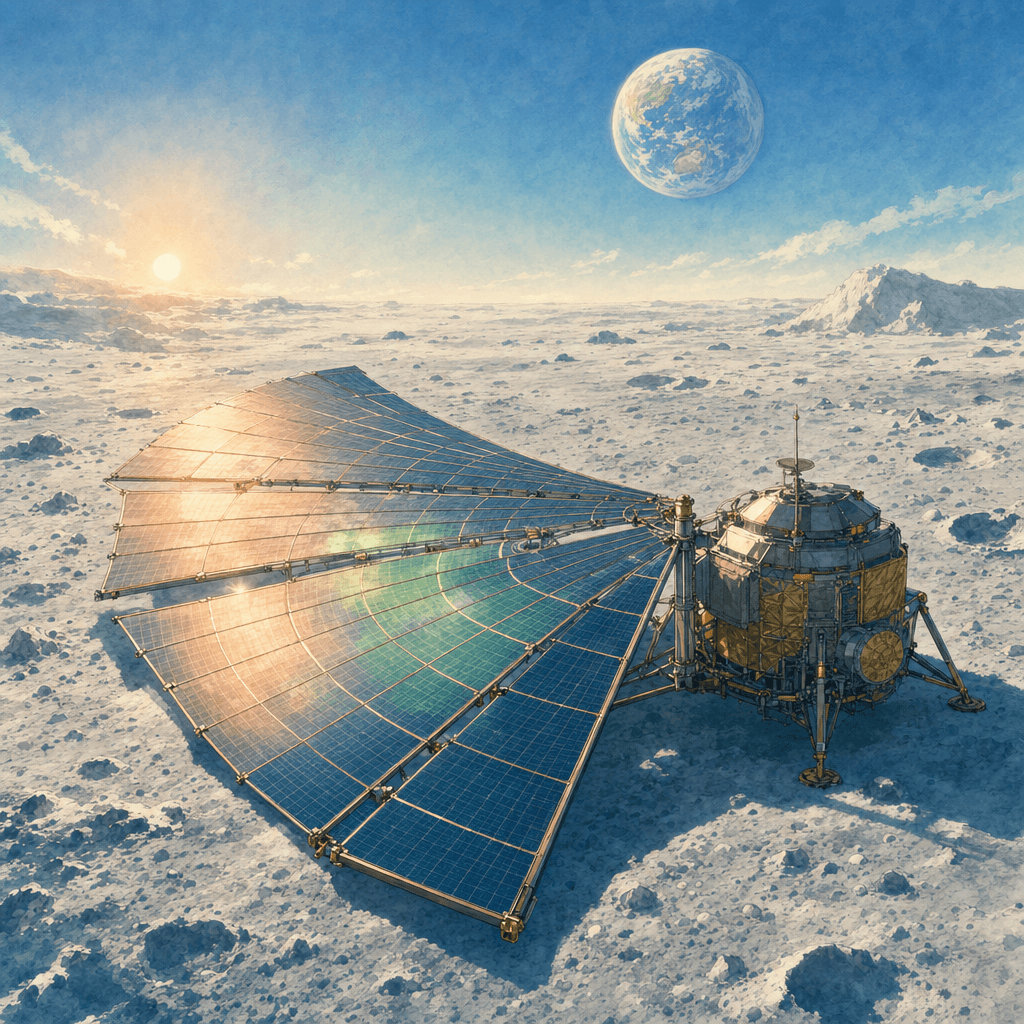
Two unrelated announcements landed within days of each other, and together they crystallise the central engineering trade-off in lunar surface power: deployable photovoltaics versus radioisotope power systems (RPS). Beyond Reach Labs unveiled its patent-pending Flarewing solar-array-deployment system, designed to fold flat inside a launch fairing and unfurl on the surface, according to Payload Space (2026-08-23). Almost simultaneously, the European Space Agency (ESA) confirmed it will make specific safety adaptations to the Ariane 6 rocket for future Argonaut lunar-lander missions that carry a Radioisotope Power System (RPS), as reported by European Spaceflight (2026). Neither announcement is a deployed system. Both are meaningful steps on the Technology Readiness Level (TRL) ladder—and the gap between them tells you a great deal about where the risk actually sits.
Deployable solar arrays on the lunar surface work by converting sunlight into electricity through photovoltaic cells mounted on panels that must survive launch vibration folded and then reliably deploy in vacuum, thermal extremes, and low gravity. The core challenge is stowage efficiency: maximising watts delivered per kilogram of stowed volume, then guaranteeing deployment without a human hand nearby. Flarewing's patent-pending fold-flat architecture directly targets that stowage problem. What the Payload Space report does not yet provide is the specific power figure—watts per kilogram (W/kg)—or the stowed volume fraction, which are the two numbers that would let a mission architect actually compare Flarewing against incumbent solutions such as the roll-out solar arrays (ROSAs) already flying on the International Space Station.
Why is ESA modifying Ariane 6 for nuclear payloads, and what does it prove?
ESA's decision to adapt Ariane 6 for RPS-carrying Argonaut missions is a regulatory and safety engineering milestone, not a power-delivery milestone. An RPS generates electricity from the heat of radioactive decay—typically plutonium-238—without any moving parts or dependence on sunlight. That makes it attractive for the lunar south pole, where permanently shadowed craters receive zero direct solar illumination and temperatures can drop below 40 K. The critical point in the European Spaceflight (2026) report is the caveat: the modifications will not be required for Argonaut's first mission. That means ESA's initial Argonaut flight remains solar-powered, and the nuclear-capable variant is a later configuration. The launch-vehicle safety adaptation is TRL progress on the ground segment of an RPS mission, not proof of an RPS in lunar operation.
These two data points map cleanly onto the demo-to-deployment curve. Flarewing is at the prototype and patent stage—call it TRL 3–4. ESA's Ariane 6 nuclear safety work represents system-level engineering on the launch side, perhaps TRL 4–5 for that specific integration challenge, while the RPS hardware itself has flight heritage from deep-space missions. Neither is a bankable lunar power plant. Both are necessary steps toward one.
What does the thermophotovoltaic result add to the picture?
French researchers have separately reported very-low-bandgap thermophotovoltaic (TPV) cells that showed more than tenfold improved performance over conventional devices at temperatures above 150 K, with a photovoltaic effect observed up to 273 K, published in PV Magazine (2026-08-24). Thermophotovoltaic cells convert infrared radiation from a heat source—such as an RPS emitter or a nuclear reactor—directly into electricity. A barrier structure in these new cells suppresses dark current, enabling operation at temperatures that would previously have been impractical. For lunar surface power architects, this is a component-level result (TRL 2–3) that could eventually improve the conversion efficiency of RPS-coupled TPV systems, closing part of the gap between raw thermal output and delivered electrical watts. The numbers are not yet at the system level, but the direction is correct.
The implication for your next decision
If you are allocating R&D budget or structuring a lunar surface power partnership right now, this week's signals point to a bifurcating market. Deployable solar arrays—whether Flarewing or a competitor—will dominate early, equatorial or mid-latitude missions where sunlight is available for at least part of the lunar day. RPS-coupled systems, potentially enhanced by improved TPV conversion cells, will be required for permanently shadowed regions and for surviving the 14-Earth-day lunar night without a massive battery stack. The question is not which technology wins; it is which mission profile you are designing for. ESA's nuclear Argonaut timeline and Beyond Reach Labs' prototype schedule will both slip if the underlying TRL gaps are not closed with funded, scheduled hardware demonstrations in the next 24 months—and neither announcement this week provides that schedule.
Created with AI assistance. Editorial oversight: Juergen Ritzek. See our AI disclosure.