Briefing · October 16, 2026
456 Starship Launches a Year: What SpaceX's FAA Filing Means for Space Solar's Cost Curve
SpaceX's bid for 456 annual Starship launches at Starbase reshapes the launch-cost ceiling every space solar roadmap is built on.
What did SpaceX actually file with the FAA in October 2026?
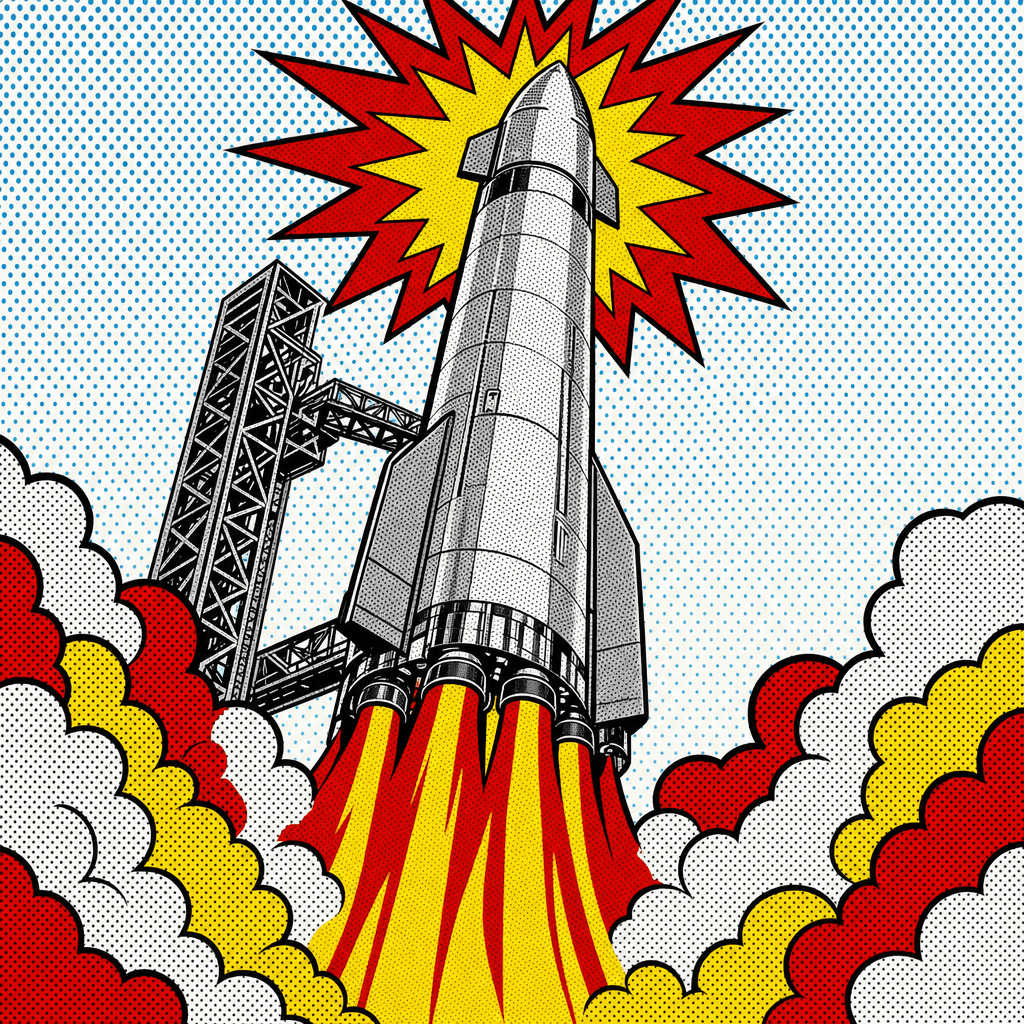
On October 12, 2026, SpaceX submitted a formal request to the U.S. Federal Aviation Administration (FAA) seeking approval for up to 456 Starship launches per year from Starbase in Boca Chica, Texas — a roughly 18-fold increase over the facility's currently approved ceiling of 25 annual launches. SatNews (2026-10-14) The filing is a regulatory milestone, not an operational one: it establishes a legal ceiling that SpaceX can grow into, and every landing counts separately, meaning the total permitted vehicle operations at Starbase would reach 912 events per year at full cadence.
That single sentence matters for every space solar roadmap in circulation today: if SpaceX achieves even one-quarter of the requested cadence at Starbase — roughly 114 Starship launches per year from Texas alone — the structural cost of lifting mass to orbit changes materially, and any business case anchored to today's launch pricing needs to be revisited now.
Why does launch cadence matter more than launch price per kilogram?
Space-based solar power (SBSP) — the concept of collecting sunlight in geostationary orbit and transmitting the resulting electricity to Earth via microwave or laser — is not primarily defeated by physics. It is defeated by the cost of lifting specific power (watts per kilogram) to orbit at a price that undercuts terrestrial solar-plus-storage, currently available in many markets below 50 USD per megawatt-hour. The mass required for a 1-gigawatt-class SBSP system under current photovoltaic and power-transmission assumptions runs to tens of thousands of tonnes. No single launch vehicle closes that equation; only cadence does.
NextBigFuture (2026-10) projects that a Starship V4 at 200 tonnes of payload per flight, flown at 5,000 launches per year across all sites, would deliver 1 million tonnes to orbit annually. The same analysis estimates that such throughput could support 50–100 gigawatts of new orbital capacity per year under current satellite power-density assumptions. The 5,000-flight figure is a speculative extrapolation, not a filed plan, and should be treated accordingly — but the underlying scaling logic applies at the 456-launch level too. At 200 tonnes per flight and 456 annual launches from Starbase alone, SpaceX's Texas pad could move over 91,000 tonnes per year, a figure that would represent most of the total mass humanity has ever placed in orbit, delivered in a single calendar year.
What this does and does not prove for SBSP developers
This FAA filing proves that SpaceX is preparing the regulatory and infrastructure groundwork for a dramatic increase in launch tempo by late 2026. It does not prove that launches will happen at that rate, that per-kilogram pricing will fall to levels that make SBSP competitive with terrestrial renewables, or that orbital assembly of large structures at scale is technically solved. Those are separate milestones — orbital demonstration of wireless power transmission, in-space solar array deployment at multi-megawatt scale, and rectenna ground infrastructure — none of which the Starbase filing addresses.
NextBigFuture (2026-10) notes that SpaceX's Florida authorizations already cover up to 44 Starship launches per year, meaning the combined permitted ceiling across both U.S. sites, if the Texas filing is approved, could reach 500 annual flights. Even at 10 percent utilization, that is 50 heavy-lift flights per year — more than the entire global launch industry managed for most of the 2010s.
Meanwhile, the ISS solar array augmentation work previewed at NASA's October 20, 2026 news conference for spacewalks 100 and 101 serves as a reminder that deploying and integrating solar arrays in orbit remains a human-intensive, slow, and expensive operation. Closing the gap between "Starship can lift the mass" and "operators can deploy and integrate the arrays" is the next unsolved problem on the SBSP critical path.
The decision your roadmap needs to make this quarter
If your organization's SBSP or orbital power business case was built on launch costs derived from Falcon 9 pricing or early Starship estimates, the Starbase FAA filing is your trigger to rerun the numbers. A higher-cadence launch environment compresses the amortized cost of lifting solar array mass — but only if your assembly and integration architecture can absorb that throughput. Model the scenario where 456 annual Texas launches are approved and 20 percent are actually flown by 2029: what does that do to your specific power target, your financing timeline, and your competitive position against terrestrial solar-plus-storage at sub-50 USD per megawatt-hour? That analysis is overdue.
Created with AI assistance. Editorial oversight: Juergen Ritzek. See our AI disclosure.